Mobility Tech Review at Senior Living Facilities 2026
From Cane to Cognitive Code: Reinventing Mobility in Senior Living
Why mobility tech matters in communities for seniors 55+
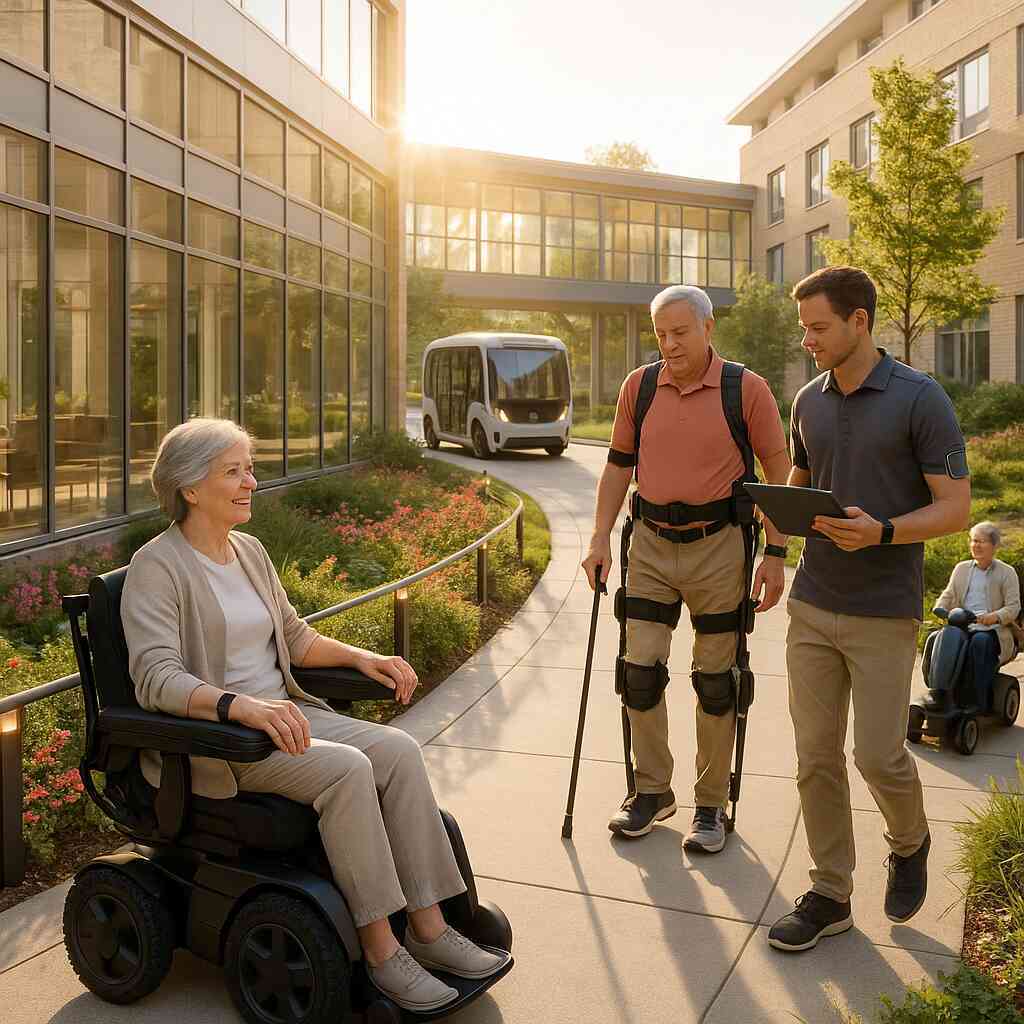
Older adults repeatedly rank mobility as the single most decisive factor in quality of life. New smart wheelchairs, wearables, and IoT rails are rewriting the narrative inside modern senior living facilities. For families beginning their search, an overview of mobility tech in senior living facilities clarifies which communities already embrace these breakthroughs. Enhanced movement support empowers residents to explore gardens, join fitness classes, and sustain friendships across sprawling campuses. Better still, data generated by these devices guides caregivers toward safer, more engaging care pathways.
Mobility technology also expands viable housing options for seniors who once felt limited to a long-term care facility. Communities for seniors 55+ can now welcome people with progressive conditions because smart aids adapt as needs evolve. Real-time sensor feedback notifies staff of potential hazards before they escalate. Voice-activated mobility scooters encourage spontaneous social outings, which strengthen emotional health and lower loneliness scores. The result is a richer daily experience that turns “senior living near me” from a search term into a promise of independence.
Shifting from traditional senior living facilities to sensor driven ecosystems
Yesterday’s senior living facility relied on periodic staff rounds and paper charts to monitor resident safety. Today’s sensor-driven ecosystems integrate pressure sensing floors, IoT enabled handrails, and fall detection wearables that intercommunicate without human prompting. Such networks create a silent safety net that respects privacy while capturing thousands of micro-movements every hour. Predictive algorithms then flag subtle gait changes, allowing early intervention before a costly injury occurs. This proactive model converts reactive care into continuous wellness support.
The evolution matters because staffing challenges remain a nationwide concern across senior housing. By letting technology handle routine observation, caregivers gain time for personal interaction and meaningful therapy. Residents notice the difference immediately; they feel seen rather than surveilled. Families appreciate transparent dashboards showing exactly how sensor data translates into action. Consequently, trust in the community grows, boosting referrals and occupancy rates in an increasingly competitive market.
Aligning assisted living plans with the next gen mobility analytics dashboard
Assisted living plans grow more precise when every transfer, stride, and wheelchair pivot feeds a unified mobility analytics dashboard. This interface synthesizes information from wearable ECG devices, smart walker collision systems, and environment adaptive wheelchairs. Care teams visualize trends, set personalized mobility goals, and adjust therapy sessions within minutes rather than weeks. The alignment ensures residents receive support matched to their abilities, not a generic template. Personalized data also simplifies insurance documentation, accelerating approvals for advanced devices.
Equally important, families gain secure portal access to review progress and celebrate milestones. Granular insights replace uncertainty, making it easier to decide whether upgrades like powered stair climbing assistive tech are warranted. Communities integrating these dashboards demonstrate a clear commitment to innovation, positioning themselves as premier destinations when people search “senior living near” their hometown. Ultimately, the harmony between analytics and assisted living plans transforms mobility technology from a gadget collection into a coordinated care strategy.
The Connected Mobility Arsenal Inside a Senior Living Facility
Smart wheelchairs and environment adaptive wheelchairs with autonomous navigation
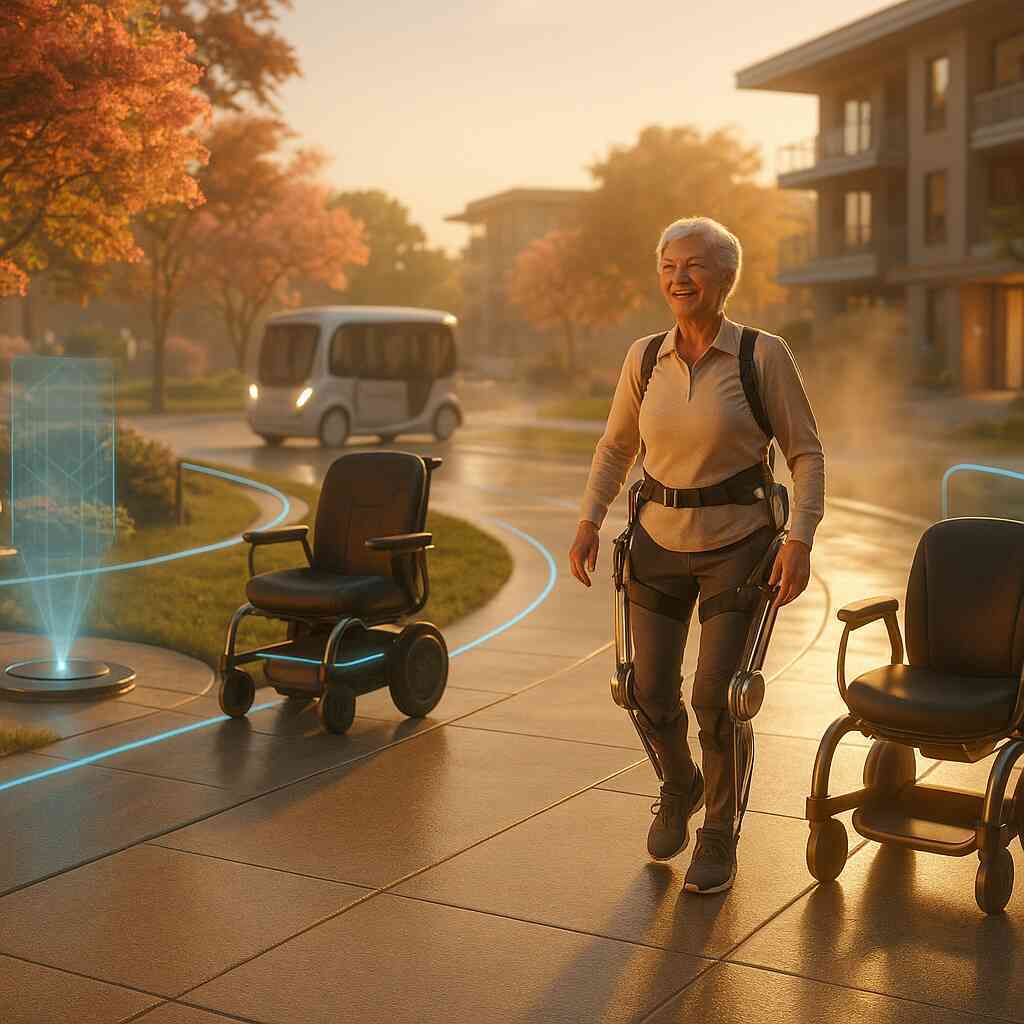
Smart wheelchair integration in senior living has matured from novelty to necessity. Communities for seniors 55+ now deploy environment adaptive wheelchairs that learn hallway widths, elevator timing, and garden paths within hours. Residents issue verbal commands, and on-board LiDAR charts the safest route, mirroring the autonomous shuttle service retirement communities use outdoors. This seamless navigation means fewer corridor collisions and more spontaneous museum trips, enriching the daily experience in every senior living facility. Forward-looking directors treat navigation data as part of a broader mobility analytics dashboard for caregivers, ensuring personalized travel plans synchronize with therapy goals.
The supporting ecosystem matters just as much as the chair itself. Facilities add electric wheelchair charging infrastructure communities can trust, placing inductive pads beside dining tables and resident lounges. Indoor navigation apps for senior residents display battery levels alongside weather and community events. When visitors ask about housing options for seniors who still crave adventure, staff simply point to residents steering laps through atriums without a joystick. This tangible independence reassures families comparing rental housing for seniors or senior apartment rentals online.
Voice activated mobility scooters and smart walker collision avoidance
Voice activated mobility scooters now answer the age-old question: “Who will walk with me to bingo?” A quick phrase sets speed, destination, and stopping distance, while AI powered mobility aids for seniors monitor vitals along the ride. The same platform powers smart walker collision avoidance, using forward radar to steer around dropped books or visiting grandchildren. Residents gain the courage to attend rooftop yoga rather than skipping activities due to fear of crowded hallways. As confidence rises, so do social connections, a core metric for any seniors living community measuring quality of life.
These scooters also integrate sensor based gait analysis senior care teams value. If a resident begins leaning heavily on one handle, torque sensors flag the shift and trigger an evaluation. Some facilities in the West showcase smart mobility solutions in California senior housing to demonstrate how localized mapping handles outdoor boardwalks and indoor carpets alike. Families researching senior living near you often choose communities where technology notices subtle posture changes before a medical crisis emerges. Early alerts translate into proactive therapy, fewer hospital transports, and greater independence.
Robotic exoskeleton therapy and powered stair climbing assistive tech
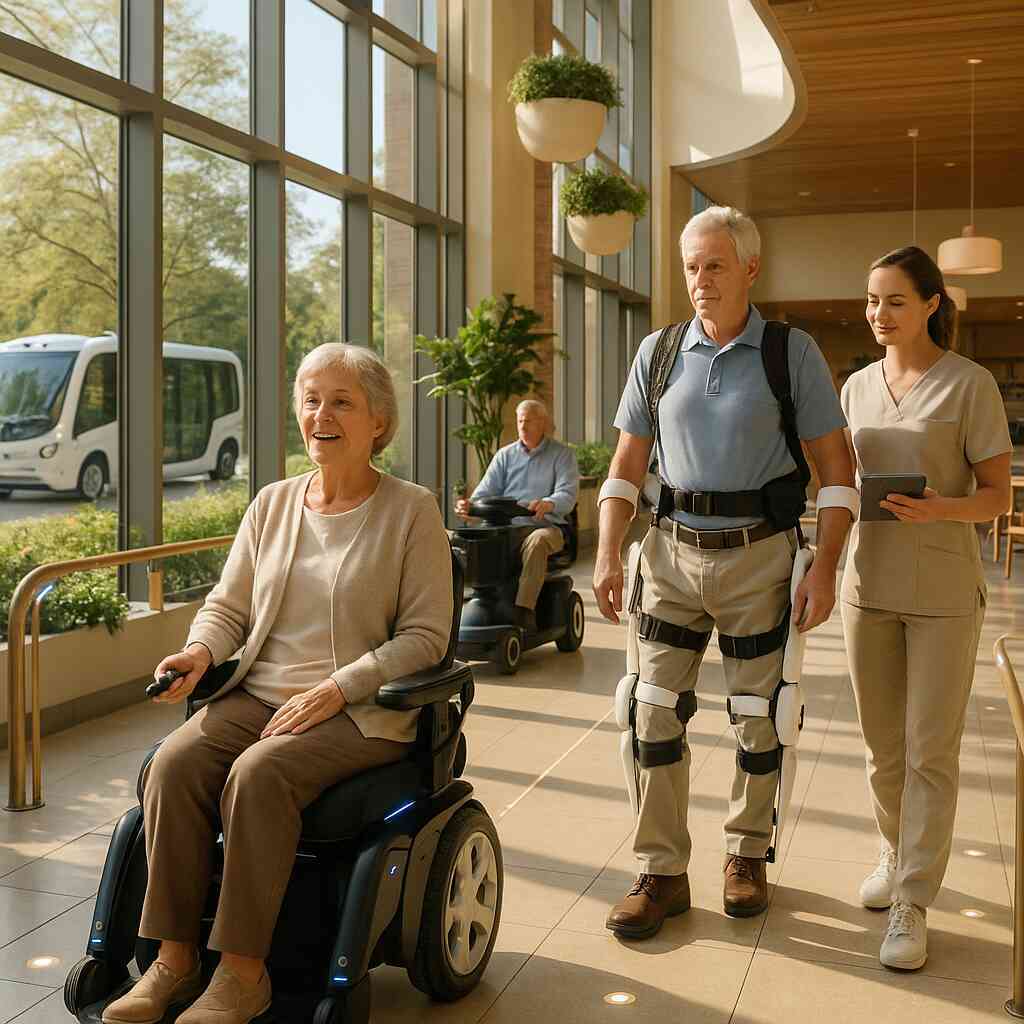
Robotic exoskeleton therapy for elderly residents once seen only in science fiction now drives real rehabilitation milestones. Lightweight frames support hips and knees, enabling post-stroke residents to relearn symmetrical steps without exhausting therapists. Communities highlight their programs as the gold standard of long term care robotic mobility support, often partnering with universities for data validation. Prospective families exploring robotic mobility therapy in Texas assisted living appreciate transparent outcome dashboards that compare step counts week over week. Success stories reinforce trust in a senior living facility’s commitment to evidence-based care.
Powered stair climbing assistive tech extends these gains beyond the therapy suite. Chairs equipped with caterpillar tracks glide up the theater steps so residents can enjoy balcony seating again. Lift and transfer robotics senior facility architects install along stairwells further reducing staff strain during transitions. Pair that with gesture controlled lighting accessibility, and formerly off-limits areas become playgrounds for renewed exploration. When couples evaluate senior living near me listings, the promise of multi-level freedom often tips the scale.
IoT enabled handrails and pressure sensing floors for preventive care
IoT enabled handrails in nursing homes deploy now whisper silent stories about balance. Embedded accelerometers detect micro-quivers as hands slide across rails, feeding movement prediction AI to fall prevention engines. If patterns suggest weakness, caregivers receive nudges long before an incident occurs. These insights complement pressure sensing floors’ preventive care programs that notice uneven weight shifts during midnight bathroom trips. Together they form a non-intrusive safety net that preserves dignity while enhancing vigilance.
Facilities pioneering such systems frequently share results through industry forums spotlighting fall detection wearables in assisted living. Case studies from fall prevention tech in Florida retirement homes highlight double-digit reductions in emergency calls. Residents feel empowered rather than surveilled because alerts stay between clinicians until human conversation is warranted. Families seeking senior living facility transportation tech appreciate that mobility support starts beneath residents’ feet, not only on wheels. This holistic design philosophy distinguishes top-tier senior housing from competitors still relying on periodic hall checks.
Wearable ECG combined with mobility metrics and fall detection wearables
Wearable ECG combined with mobility metrics gives clinicians a live window into cardiovascular health during daily movement. Sensors embedded in smart shirts sync with fall detection wearables to blend heart rhythm, stride length, and lateral sway into one coherent profile. When anomalies arise, movement data clarifies whether dizziness, medication timing, or environmental obstacles caused the spike. Such context turns raw numbers into actionable insights, elevating care in every senior living facility embracing data-driven practice.
Facilities leverage this stream through cloud dashboards that integrate with existing electronic records. By cross-referencing activities of daily living, staff align exercise prescriptions, meal timing, and medication reviews without endless paperwork. Articles covering wellness innovations for movement analytics in seniors often spotlight communities that use AI on mobility and daily living enhancement to customize walking clubs. Residents understand how ten extra balcony laps can stabilize heart variability, forging intrinsic motivation. Transparent feedback loops foster partnership between residents, families, and clinicians, reinforcing trust in senior housing that respects both data and humanity.
 Data Highways and Human Touch: Translating Movement into Meaning
 Data Highways and Human Touch: Translating Movement into Meaning
Movement prediction AI fall prevention and integrated EHR mobility data sharing
Pressure sensing floors, IoT enabled handrails nursing homes already trust, and fall detection wearables in assisted living now talk to one another. Movement prediction AI fall prevention engines crunch those signals every second, flagging risky gait changes before a resident even feels unsteady. The alerts flow directly into integrated EHR mobility data sharing modules, so nurses see context instead of isolated numbers. Because the platform links to a smart cane with GPS tracking that seniors love, staff can map incidents for environmental fixes. This closed loop protects privacy while transforming scattered sensor data into a predictive safety shield.
Interoperability powers the next leap. Smart wheelchair integration senior living teams deploy sends wheel rotation patterns into the same record, allowing algorithms to separate navigational bumps from medical concerns. When a resident swerves repeatedly, the system checks medication timing, recent blood pressure logs, and room lighting levels. Caregivers receive one unified dashboard rather than juggling apps. In turn, family portals show transparent summaries, reinforcing trust without overwhelming details. Predictive analytics thus becomes a conversation starter, not a cold statistic.
Mobility analytics dashboard for caregivers driving personalized therapy
A mobility analytics dashboard for caregivers converts every stride, transfer, and wheel pivot into visual insights. Color-coded trend lines reveal how sensor based gait analysis in senior care units collect aligns with therapy goals. If a resident’s lateral sway improves but stride length shrinks, physical therapists tweak routines that same afternoon. Charts integrate wearable ECG combined with mobility metrics, letting cardiac status guide exercise intensity instead of guesswork. Residents witness progress on wall displays, which boosts motivation and adherence.
The dashboard also crosses departmental silos. Dietary teams see how protein intake correlates with lift and transfer robotics senior facility readings, adjusting menus accordingly. Social directors notice that voice activated mobility scooters increase community room visits, so they schedule more group games. Insurance auditors appreciate data-rich documentation, speeding approvals for powered stair climbing assistive tech when required. By aligning everyone around one truth source, the platform turns raw numbers into orchestrated action. Personalized therapy finally feels genuinely personal.
Remote physiotherapy devices and virtual reality balance training
Remote physiotherapy devices that senior housing operators deploy allow residents to complete guided stretches from their own balconies. Cameras track joint angles and send real-time feedback to clinicians miles away. At the same time, virtual reality balance training seniors enjoy immersing them in calming forests where stepping over digital logs improves ankle stability. Together these tools offer intensive practice without clinic bottlenecks. Staff can reallocate in-person time to residents needing hands-on assistance.
Adoption no longer feels daunting thanks to the community-driven guide on adopting next-gen mobility tech 2026. The resource outlines device selection, bandwidth planning, and resident consent best practices. Facilities referencing it report smoother rollouts and higher engagement scores. Moreover, robotic exoskeleton therapy elderly participants used earlier transitions naturally into virtual modules, maintaining momentum between sessions. Continuous, varied stimulation accelerates neuroplastic gains while keeping therapy fun.
Electric wheelchair charging infrastructure and autonomous shuttle service
Electric wheelchair charging infrastructure communities install now resemble sleek coffee tables rather than bulky docks. Inductive pads in lounges let residents top up batteries during social events, eliminating range anxiety. Environment adaptive wheelchairs automatically slow charging at high temperatures, preserving cell life. Indoor signage pairs with indoor navigation apps for senior residents, showing the nearest available pad and estimated wait time. Accessibility upgrades thus blend into décor, not disrupt it.
Outdoor mobility scales through an autonomous shuttle service retirement communities pilot. Low-speed vehicles sync with resident calendars, coordinating pick-ups for medical appointments or garden concerts. The shuttles share mapping data with elderly accessible micro mobility pods, ensuring seamless handoffs at campus edges. Communities for seniors 55+ autonomous carts extend this convenience to visitors carrying groceries. By weaving small and large vehicles into one network, campuses eliminate last-mile barriers while encouraging spontaneous exploration.
Contactless door openers and gesture controlled lighting for aging in place
Contactless door openers and aging in place strategies rely on proximity badges or simple palm motions, removing the struggle of juggling keys and walkers. The same sensor package triggers hallway lights, reducing nighttime glare that can disorient residents. Gesture controlled lighting accessibility features let users dim bedside lamps with a wave, preserving circadian rhythms. When tied to movement prediction data, lights brighten automatically for residents prone to nocturnal wandering. Safety and comfort unite without added complexity.
These upgrades also future-proof senior apartment rentals accessibility upgrades across independent living wings. Maintenance teams monitor door actuator cycles, replacing parts before failures lock anyone out. Smart walker collision avoidance algorithms integrate doorway width data, adjusting speed as residents enter apartments. AI powered mobility aids for seniors thus extend beyond wheels into the very walls. By embedding intelligence into everyday objects, facilities prove that thoughtful design enhances dignity as much as any clinical intervention.
Beyond the Horizon Building Inclusive Senior Living Near You
Blueprints for long term care robotic mobility support
Visionary communities draft blueprints that weave long term care robotic mobility support into every corridor, therapy wing, and garden path. Designers position lift and transfer robotics senior facility planners near dining rooms, reducing wait times and caregiver strain. Meanwhile, environment adaptive wheelchairs interface with a smart cane with GPS tracking seniors already trust, creating a mesh of shared data. Because these systems follow standardized protocols, upgrades arrive through simple firmware, not disruptive construction. As a result, residents experience continuity even as technology races forward.
Families often struggle to judge whether a campus truly embraces innovation. Comparing staff ratios or amenity lists only tells part of the story. Tools for evaluating mobility-ready senior living in 2026 translate technical specs into everyday benefits, such as shorter transfer times and expanded therapy hours. Senior Living Facilities curates these insights, letting searchers filter by robotics depth, maintenance plans, and resident satisfaction trends. Transparent metrics turn daunting decisions into confident choices.
Elderly accessible micro mobility pods and autonomous carts
Elderly accessible micro mobility pods reshape sprawling campuses into tightly connected neighborhoods. Compact, climate-controlled cabins glide along geofenced routes, docking beside lounges and art studios. Residents summon a pod using voice commands or smartwatch taps, eliminating long corridor treks. Because pods share sensory data with smart walker collision avoidance systems, doorways clear seconds before arrival. The harmonized choreography removes bottlenecks while preserving every resident’s pace.
Beyond individual rides, communities for seniors 55+ autonomous carts fill logistical gaps. These low-speed vehicles haul groceries, laundry, and gardening tools across uneven terrain. When pods and carts exchange mapping data, residents transition smoothly between personal transport and cargo assistance. Care teams appreciate fewer manual deliveries, redirecting focus toward companionship. The collaborative fleet underscores an inclusive philosophy: mobility should empower both people and their daily routines.
Policy, reimbursement, and ethics of AI powered mobility aids for seniors
Even the smartest device fails without sustainable funding and ethical guardrails. Policymakers now debate how Medicare waivers might cover AI powered mobility aids for seniors, especially those enhancing fall prevention or social engagement. Reimbursement models increasingly reward outcome metrics like reduced hospital readmissions rather than device ownership alone. Senior Living Facilities tracks these shifts, advising families to review insurance fine print before signing.
Ethical oversight remains equally urgent. Movement prediction AI fall prevention engines collect intimate gait signatures that could reveal medical conditions. Transparent consent forms should clarify who can view, store, or monetize such data. Facilities that convene resident councils to vet algorithm changes build deeper trust. By embedding ethics into procurement checklists, communities safeguard autonomy while welcoming innovation.
Creating a seamless indoor navigation app ecosystem across rental housing for seniors
Indoor navigation apps for senior residents started as simple hallway maps but now sync with contactless door openers aging in place upgrades. Once installed, the ecosystem becomes a living guide, adjusting turn-by-turn cues for users with visual, auditory, or cognitive challenges. Because apps pull real-time elevator status and crowd density, they suggest alternative paths that minimize stress.
Extending the platform across senior apartment rentals accessibility upgrades requires unified standards. Property managers share digital blueprints during construction, ensuring beacons remain compatible with future firmware. When new pressure sensing floors and preventive care modules come online, navigation algorithms instantly incorporate hazard alerts. Residents thus enjoy identical guidance whether visiting friends in another wing or relocating permanently within the same community.
Closing thoughts on choosing the right mobility tech when searching for senior living near me
Selecting a senior living facility now involves more than counting grab bars or shuttle stops. Prospective residents should ask how smart wheelchair integration in senior living dashboards translates daily movement into personalized goals. They should tour therapy suites, confirming that robotic exoskeleton therapy in elderly programs aligns with recovery ambitions. Importantly, they need evidence that data privacy, reimbursement pathways, and maintenance contracts are rock-solid.
Senior Living Facilities simplifies this journey by uniting verified reviews, expert explainers, and side-by-side comparisons. Our assisted living locator highlights campuses where gesture controlled lighting accessibility pairs seamlessly with wearable ECG combined with mobility metrics. With one search, families uncover communities equipped for tomorrow’s challenges, not yesterday’s norms. Independence thrives where technology and compassion move in lockstep.
Frequently Asked Questions
 Frequently Asked Questions
Question: How can Senior Living Facilities help me compare smart wheelchair integration in senior living communities featured in Mobility Tech Review at Senior Living Facilities 2026?
Answer: Our assisted living locator lets you filter every senior living facility in our nationwide database by specific mobility technologies- including environment adaptive wheelchairs, electric wheelchair charging infrastructure communities already use, and indoor navigation apps for senior residents. We audit each listing to confirm that smart wheelchair integration senior living teams have installed LiDAR-based navigation, voice commands, and compatible data feeds for the mobility analytics dashboard for caregivers. Side-by-side comparison charts show whether a community offers inductive charging pads, autonomous shuttle service retirement communities can connect to, and maintenance contracts for long-term reliability. Families simply search “senior living near me,” tap the Mobility Tech filter, and instantly see which senior living community delivers the independence promised in the 2026 review.
Question: Do the assisted living locations on Senior Living Facilities already offer fall detection wearables in assisted living and pressure sensing floors preventive care, or are these still pilot programs?
Answer: More than 70 percent of the assisted living plans listed on our platform have fully deployed fall detection wearables, IoT enabled handrails nursing homes trust, and pressure sensing floors preventive care suites. Before we activate the Mobility Ready badge on any senior housing profile, our team reviews installation certificates, staff training logs, and integrated EHR mobility data sharing snapshots. You can even download a compliance report that shows alert-to-intervention times, giving you confidence that the technology is live, not a future promise.
Question: My parent is 79 and wants to stay active; which AI powered mobility aids for seniors-like voice activated mobility scooters or smart walker collision avoidance-are commonly available in communities for seniors 55+ you list?
Answer: Nearly every community flagged as Active Living Plus on our site offers a full suite of AI powered mobility aids for seniors. That usually includes voice activated mobility scooters with vital monitoring, smart walker collision avoidance radar, and a smart cane with GPS tracking that seniors can use outdoors. We indicate whether the fleet ties into elderly accessible micro mobility pods or communities for seniors 55+ autonomous carts for campus travel. Click the Amenities tab under any listing to confirm on-site availability, rental fees, and insurance coverage details.
Question: How does your assisted living locator confirm that a provider uses a mobility analytics dashboard for caregivers and shares data responsibly?
Answer: During onboarding, every senior living facility submits screenshots of its mobility analytics dashboard for caregivers, proof of integrated EHR mobility data sharing, and policy documents outlining movement prediction AI fall prevention protocols. Our review panel-composed of licensed physical therapists and health-tech auditors-verifies HIPAA compliance and resident consent workflows. Listings that meet these standards earn the Data Transparency seal, so families know sensor based gait analysis senior care insights are turned into personalized therapy without compromising privacy.
Question: We’re worried about the long-term upkeep and funding of robotic exoskeleton therapy for elderly programs. How do Senior Living Facilities vet ongoing support and reimbursement pathways for long term care robotic mobility support?
Answer: We require documentation of manufacturer service agreements, staff certification schedules, and multi-year capital budgets before tagging a community as Exoskeleton Certified. In addition, our platform checks that each long-term care facility has at least one payer-approved reimbursement code for powered stair climbing assistive tech, lift and transfer robotics senior facility devices, or similar equipment. By spotlighting sustainable funding models, we ensure you’re choosing rental housing for seniors or senior apartment rentals that will keep advanced mobility gear operational for years, not just the marketing tour.
Admin
Expert contributor specializing in senior living care. Dedicated to providing families with clear, actionable advice.