Review Cognitive Fitness at Senior Living Facilities
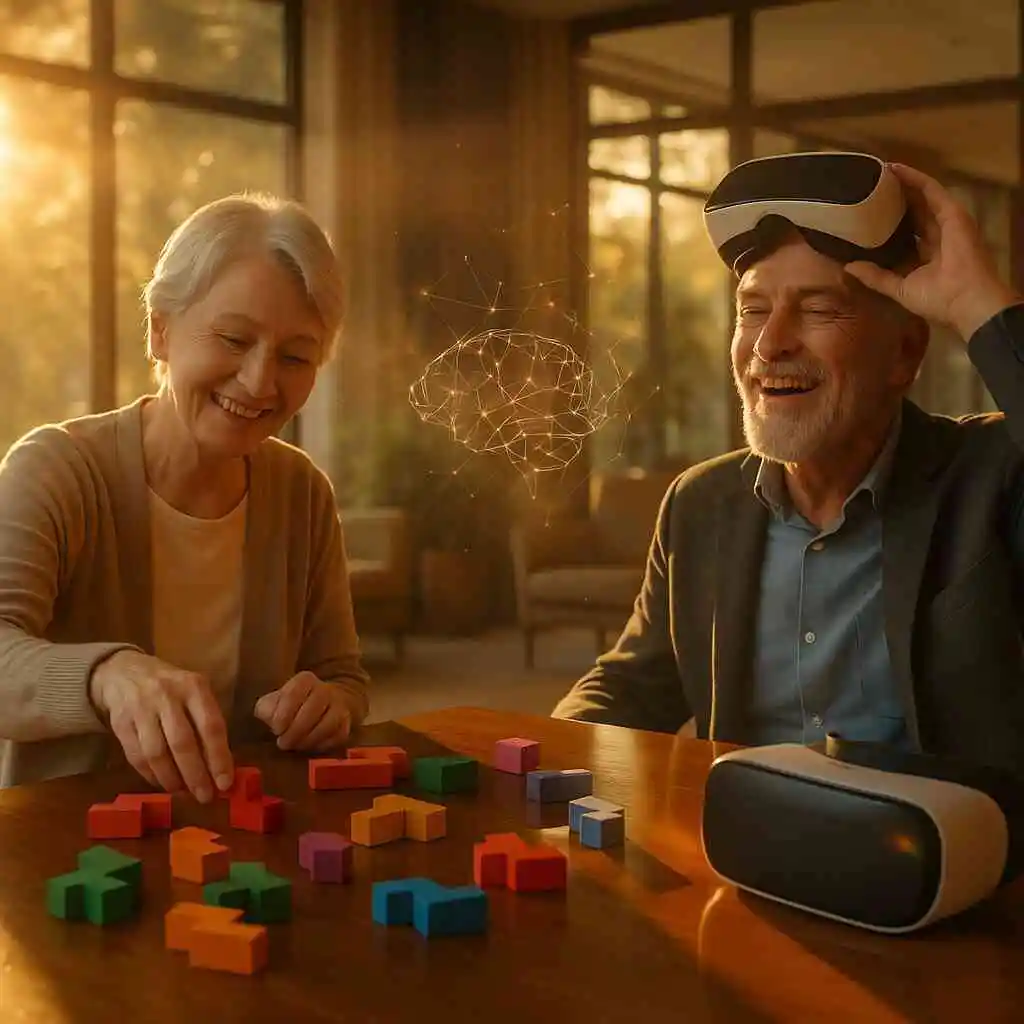
Opening the Doors to Cognitive Vitality in Senior Living Communities
Defining cognitive fitness for today’s aging brain
Cognitive fitness describes the brain’s capacity to learn, remember, and adapt across the lifespan. Scientists compare it to physical conditioning because regular training keeps neurons flexible. Strategic mental challenges, a balanced lifestyle, and emotional well-being all strengthen synaptic networks. Together they reinforce attention, executive function, and memory recall abilities vital for independent living. Consequently, today’s aging brain can remain agile when nurtured through evidence-based routines.
Forward-thinking senior living facilities translate these principles into daily programming. Residents explore cognitive fitness programs in senior living facilities featuring puzzles, language lessons, and mindfulness at senior living near me. Each activity targets a different neural pathway, creating a full-body workout for the mind. Furthermore, professional staff regularly refine exercises to match individualized goals, protecting dignity while maximizing challenge. Therefore, families see measurable progress instead of passive aging.
How senior living facilities foster intellectual engagement from day one
Moving into a senior living facility does not signal the end of discovery; it ignites a structured exploration. Orientation teams begin by mapping each resident’s passions and preferred learning styles. That personal blueprint guides immediate integration into book circles, art studios, or technology labs. Because early connections matter, mentors accompany newcomers to brain health workshops for older adults, easing nerves while inspiring curiosity. Within days, participants feel valued contributors rather than passive observers.
Equally important, activity directors curate on-demand libraries, online lectures, and hands-on labs, all cataloged inside an intuitive portal. Residents and families browse these cognitive fitness resources in senior living facilities to schedule personalized enrichment with a single click. The platform highlights class intensity, evidence level, and social opportunities, ensuring informed choices from day one. Consequently, no talent remains hidden; every resident can nurture strengths and stretch weak regions. Such immediate empowerment builds confidence and sets a positive trajectory for lifelong neuroresilience.
The link between social connection and mental sharpness in communities for seniors 55+
Research consistently shows that isolation accelerates cognitive decline, whereas meaningful friendships strengthen neural circuits. Therefore, communities for seniors 55+ design calendars bursting with collaborative games, volunteer projects, and debate salons. Each shared experience demands attention, memory retrieval, and perspective taking, all vital for executive function training for seniors. Because interactions feel purposeful, residents naturally sustain participation, converting routine moments into cognitive workouts. Staff measure engagement levels weekly to spot anyone drifting toward loneliness and intervene early.
Cutting-edge communities even quantify social well-being with digital surveys linked to cognitive screening results. The data reveal that just a few extra meaningful conversations each day can slow memory loss trajectories. One national study noted that programs focused on communal art creation delivered larger memory gains than solitary puzzles. Consequently, directors prioritize group formats when building new dementia prevention activities in retirement homes. Families reviewing options should therefore examine both class offerings and social integration metrics before selecting a residence.
In addition, intergenerational partnerships with local students infuse fresh topics and digital skills into the conversation. Grandparent mentors describe new applications, while teenagers explain emerging technologies, creating reciprocal learning that stimulates both groups. These cross-age dialogues enhance processing speed and keep cultural references current, supporting aging brain vitality programs. Most importantly, they reinforce the message that an older adult’s wisdom remains relevant and valued. Feeling purposeful continues to be the strongest cognitive safeguard science has documented so far.
Charting the Brain Health Journey with Personalized Assessments
Senior cognitive wellness assessments that inform targeted care plans
Every transformative wellness journey begins with measurement. At a modern senior living facility, baseline testing maps individual strengths and risks. These senior cognitive wellness assessments go far beyond simple memory quizzes. They evaluate attention span, language recall, executive flexibility, and emotional tone. Licensed clinicians administer standardized neuropsychological batteries in a calm, friendly setting. Results are then combined with lifestyle data, including sleep patterns and activity preferences. Because evidence drives action, each metric feeds a personalized cognitive therapy plan. Residents see their unique brain profile beautifully visualized and easy to understand. Families appreciate concrete numbers instead of vague reassurance. Confidence rises when everyone knows the starting line.
Interdisciplinary teams review the data during weekly memory care and mental acuity reviews. Speech therapists, occupational therapists, and wellness coaches interpret patterns together. Their collaborative notes guide cognitive rehabilitation services in long-term care facilities across the campus. If assessments reveal mild attention slips, directors schedule neuroplasticity exercises in assisted living communities earlier in the day. Elevated stress markers prompt recommendations for mindfulness sessions at senior living near me. When scores flag potential dementia risk, immediate dementia prevention activities in retirement homes are added. This proactive loop converts static testing into a living roadmap. Residents witness rapid, targeted adjustments instead of generalized programming. Every tweak feels relevant, motivating sustained participation.
Technology based cognitive screening tools are available at senior living near me
Technology now accelerates screening accuracy while reducing resident fatigue. Touchscreen tablets present adaptive questions that adjust difficulty in real time. These technology-based cognitive screening tools produce granular insights within fifteen minutes of interactive play. Algorithms immediately flag unusual delays, guiding clinicians toward deeper evaluation. Importantly, interface design considers arthritic hands and visual changes, ensuring accessibility. Audio prompts, large icons, and optional stylus controls keep frustration low. Data is encrypted on-device and syncs to secure electronic health records. Families can review summaries through a portal from anywhere. Transparency fosters trust and shared decision making. Screening feels modern, not medical, which encourages higher completion rates.
In addition, some campuses pilot AI-driven mental agility tools for aging adults that learn each user’s pattern over weeks. The system compares daily performance against personal baselines, rather than population averages. When micro-declines appear, an alert sends suggested mental agility games for seniors 55+ communities directly to activity directors. Because feedback arrives quickly, supportive interventions launch before noticeable functional loss occurs. These platforms integrate with wearables, joining heart rate variability and sleep hygiene trends to cognitive charts. Professionals view the combined dashboard and schedule the holistic brain gym for aging adults accordingly. Residents appreciate seeing colorful progress circles grow. Visual reinforcement strengthens motivation and adherence.
Executive function training and memory care insights for assisted living plans
Executive processes-planning, shifting, and inhibition-govern everyday independence. Therefore, assisted living plans incorporate structured executive function training for seniors into daily calendars. Residents practice sequencing tasks through interactive puzzles in senior apartment rentals and kitchen simulations. Therapists break complex goals into incremental steps, providing immediate feedback that locks in procedural memory. Over time, incremental mastery flows into confident self-management of activities of daily living linked to brain health. Social games such as collaborative book clubs for mental stimulation further challenge flexible thinking. By alternating solitary drills with group debates, the program avoids monotony. Consistency, variety, and personal relevance combine to strengthen prefrontal circuitry.
Data from biannual testing feeds dashboards that reveal which drills yield measurable gains. Clinicians share these patterns during interdisciplinary meetings. They focus on guiding memory care strategies at senior housing. When residents struggle with multi-step sequencing, staff introduce music therapy boosting memory recall paired with gentle movement. Music’s rhythmic cues help time executive shifts and improve initiation. Meanwhile, virtual reality brain training in nursing homes offers immersive scenarios for safe trial and error. Success rates inform subsequent personalized cognitive therapy plans, ensuring resources flow where they matter most. Residents celebrate milestones during peer-led discussion groups for mental sharpness, reinforcing progress socially.
Integrating bilingual memory enhancement to serve diverse older Americans
The United States hosts a rich tapestry of languages, and cognitive programs must honor that diversity. Bilingual memory enhancement for older Americans recognizes that switching tongues itself exercises attention networks. Facilities recruit multilingual coaches to deliver brain health workshops for older adults in residents’ preferred languages. Lessons incorporate culturally familiar stories, songs, and proverbs, strengthening emotional resonance. This approach not only nurtures identity but also activates deeper mnemonic encoding. Residents alternate between languages during word-association games, stretching neural pathways. Because instruction feels personal, participation climbs. Families witness grandparents sharing childhood poems with newfound clarity, transforming therapy into a heritage celebration.
In addition, staff measure retention gains alongside social connection and cognitive health support metrics. Research shows that language inclusion amplifies relational bonds, which advances aging brain vitality programs. Results appear in the same secure portal used for lifestyle review for optimal brain health. When bilingual groups outperform monolingual cohorts, directors replicate the model across campuses. They also adapt executive function training materials, ensuring every infographic includes dual-language captions. Continuous learning opportunities in senior living communities therefore become equitable. By meeting residents where they are linguistically, facilities expand both cognitive reserve and communal trust. Such inclusive design underscores the mission of personalized, respectful care.
 The Cognitive Fitness Ecosystem Across Senior Living Facilities
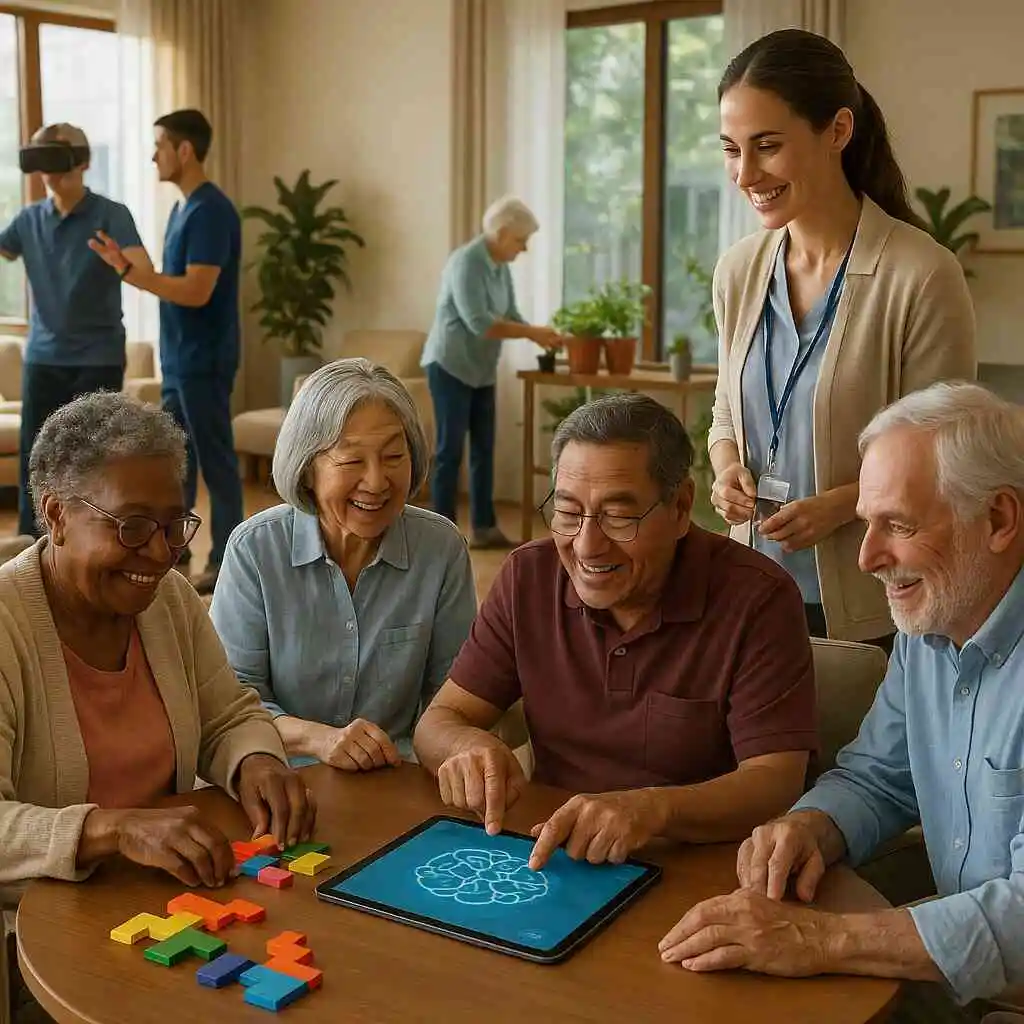 The Cognitive Fitness Ecosystem Across Senior Living Facilities
Brain health workshops and neuroplasticity exercises are powering mental agility games
Brain health workshops for older adults introduce the science behind learning, then immediately apply it through guided neuroplasticity exercises in assisted living communities. Instructors explain how novelty sparks dendrite growth, motivating residents to tackle new card strategies or language drills. Because sessions emphasize mastery over perfection, participants experiment without fear, which further amplifies synaptic change. Consistent attendance translates into measurable gains during memory care and mental acuity reviews, reinforcing commitment. Families notice sharper conversation flow, validating the program’s practical value.
Additionally, facilitators blend mental agility games for seniors 55+ communities with uplifting social rituals. Teams rotate leadership roles, promoting executive flexibility while deepening friendship networks that guard against isolation. Real-time scoreboards encourage gentle competition, keeping attention focused and reactions quick. A monthly showcase highlights success stories and reveals upcoming innovations, such as sensory integration tasks or narrative therapy prompts. Readers can explore recent wellness innovations enhancing brain vitality in retirement homes to see how these ideas evolve nationwide.
Virtual reality brain training and interactive puzzles in senior apartment rentals
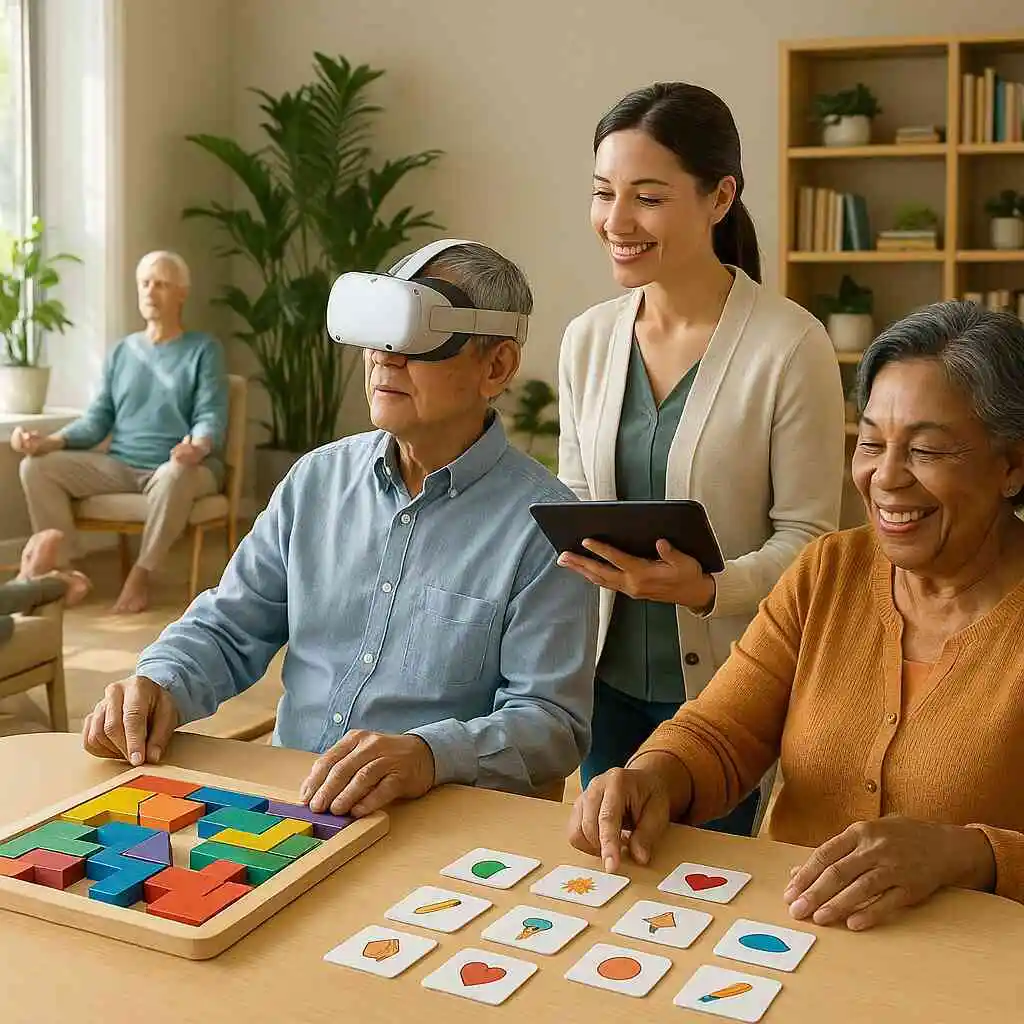
Virtual reality brain training in nursing homes immerses residents in safely simulated adventures that challenge spatial memory, hand-eye coordination, and emotional regulation. Guided by therapists, participants navigate digital gardens, identify songbirds, or follow choreographed tai chi moves. Every scenario adjusts difficulty based on biometric feedback, preventing frustration and sustaining flow. Data syncs with personalized cognitive therapy plans, allowing teams to track progress across multiple domains. Elders often describe the sessions as exhilarating mini-vacations, boosting mood alongside cognition.
Interactive puzzles in senior apartment rentals extend the workout long after VR headsets rest on charging docks. Tablet-based escape rooms demand collaborative problem solving, while oversized wall puzzles improve fine-motor control for residents with arthritis. Weekly leaderboards spark hallway conversations that reinforce recall of names, dates, and strategies. Maintenance staff even hide QR-coded clues near elevators, turning routine walks into scavenger hunts. This playful design turns independent living spaces into continuous learning laboratories.
Music therapy book clubs and peer led discussion groups for continuous learning
Music therapy boosting memory recall leverages rhythm’s unique ability to synchronize neural firing. Certified therapists guide residents through familiar melodies, then invite lyrical improvisation that stimulates language centers. Instruments with color-coded notes welcome participants with no prior training, ensuring inclusivity. After each session, attendees record emotional ratings, which help staff tailor future playlists toward optimal arousal levels. Over weeks, many residents recount dormant memories triggered by certain chords, enriching personal narratives.
Collaborative book clubs for mental stimulation can pick up this momentum by discussing themes uncovered during music sessions. Peer facilitators rotate chapters, challenging executive function training for seniors through planning and summarizing responsibilities. Debates remain respectful yet lively, pushing flexible thinking and perspective taking. Staff supply graphic organizers that map character arcs, aiding those with mild cognitive impairment. Members leave each meeting energized, often continuing discussions over dinner or video chat.
Sleep hygiene nutrition and stress reduction strategies for dementia prevention
Sleep hygiene and cognition in senior housing share a powerful relationship; deep rest consolidates memories and clears metabolic waste. Wellness coaches teach residents to sync evening routines with natural circadian cues, dimming lights and practicing gentle stretches. Technology teams install blue-light filters on communal televisions, protecting melatonin production. Monthly seminars review personal sleep logs, offering tailored solutions such as weighted blankets or white-noise machines. Improvements quickly appear in morning attention tests.
Nutritional strategies for cognitive longevity complement rest by fueling neurotransmitter synthesis and reducing inflammation. Chefs craft brain-healthy menus featuring omega-rich fish, leafy greens, and antioxidant berries. Interactive cooking classes empower residents to replicate recipes in apartment kitchens, reinforcing autonomy. Meanwhile, stress reduction workshops at assisted living locations teach diaphragmatic breathing and guided imagery, lowering cortisol that can impair memory circuits. Together, these lifestyle pillars create a robust defense against dementia progression.
Holistic brain gym modules and occupational therapy for cognitive resilience
Holistic brain gym for aging adults incorporates balance boards, memory stations, and mindfulness corners within a single circuit. Residents might recite poetry while performing gentle leg raises, merging physical and cognitive demands that enhance neural integration. Timers ensure appropriate work-to-rest ratios, preventing fatigue while maintaining challenge. Progress charts display colorful trajectories, motivating consistent participation. The gym welcomes wheelchair users through adaptive equipment, affirming universal design principles.
Occupational therapy for cognitive resilience then translates gym gains into daily routines. Therapists analyze tasks like medication management or online banking, breaking them into sequential steps that reinforce executive planning. They introduce color-coded pill organizers, voice-activated reminders, and ergonomic kitchen tools. Such modifications safeguard independence while continuing skill rehearsal outside formal sessions. Graduates often mentor newcomers, creating a sustainable peer support loop that strengthens the entire seniors living community.
Sustaining Lifelong NeuroResilience Beyond the Facility Walls
Caregiver education on cognitive support for smoother transitions home
Family members often feel anxious when a loved one leaves the structured safety of a senior living facility. Comprehensive caregiver education on cognitive support turns that anxiety into confidence. Clinicians demonstrate how everyday cues, such as labelled drawers and visual calendars, reinforce activities of daily living linked to brain health. They also explain why consistent routines lower mental fatigue and help synapses stabilize new learning. Written guides translate clinical jargon into clear, actionable checklists for the home environment.
Senior Living Facilities extends this teaching through virtual seminars that blend live demonstrations with Q&A forums. During workshops, professionals showcase adaptive devices that simplify medication management and promote executive function training for seniors in familiar settings. Recordings are archived in an online library, allowing caregivers to revisit lessons whenever questions arise. Finally, follow-up calls ensure that personalized cognitive therapy plans remain effective as real-world challenges surface.
Collaborative partnerships with local universities for ongoing intellectual engagement
Forward-thinking communities sign memoranda with nearby universities to create mutual learning ecosystems. Professors design mini-courses on digital art, climate science, or genealogy that align with cognitive fitness programs in senior living facilities. Residents attend these lectures on campus or through streaming portals, keeping minds agile while expanding social circles beyond peers. In turn, graduate students collect anonymized data to study neuroplasticity exercises in assisted living communities, advancing the field.
Intergenerational labs also encourage residents to mentor students in life skills, thereby reinforcing their own memory recall. Joint choirs, robotics clubs, and debate teams demand rapid problem-solving, which sharpens processing speed. Such collaborations exemplify holistic health roles of senior living for cognitive resilience by merging scholarly stimulation with purpose-driven social contact. Alumni celebrations become multigenerational reunions that demonstrate learning truly knows no age boundary.
Lifestyle review tips to maintain aging brain vitality wherever seniors live
Neuroresilience thrives on consistent self-audits. Wellness coaches recommend a quarterly lifestyle review for optimal brain health, covering sleep quality, nutrition, movement, and stress levels. Residents can access an interactive checklist through the Senior Living Facilities portal to track progress. Color-coded dashboards reveal patterns, prompting timely adjustments before minor lapses escalate. This simple habit converts awareness into preventive action.
For additional guidance, families can find brain-health focused senior living near me to compare community resources that complement at-home routines. Even short-term respite stays introduce fresh brain health workshops for older adults, offering new techniques to bring back home. Finally, regular community meet-ups-virtual or in person-reinforce mental agility games for seniors 55+ communities, ensuring that cognitive momentum never stalls, regardless of address.
Frequently Asked Questions
 Frequently Asked Questions
Question: How do Senior Living Facilities evaluate cognitive fitness when guiding families toward the right senior living facility?
Answer: We begin every search with senior cognitive wellness assessments that measure memory, attention, and executive function. Many of the communities in our network now use technology-based cognitive screening tools that adapt to each user in real time, producing granular data in just minutes. These results feed into regular memory care and mental acuity reviews, allowing our assisted living locator team to match your loved one with a campus where clinicians constantly monitor progress and update personalized cognitive therapy plans. Because our directory spans all 50 states, you can compare assessment protocols side by side before you ever schedule a tour.
Question: What kinds of cognitive fitness programs in senior living facilities-like those featured in the blog Review Cognitive Fitness at Senior Living Facilities-can residents enjoy?
Answer: The communities we recommend offer a full spectrum of brain-boosting options, from executive function training for seniors and neuroplasticity exercises in assisted living communities to holistic brain gym for aging adults circuits that blend movement with mental challenges. Residents might join virtual reality brain training in nursing homes, interactive puzzles in senior apartment rentals, or music therapy boosting memory recall sessions. Each activity is evidence-based, fun, and adaptable, ensuring older adults receive the right level of challenge while building social connection and cognitive health support.
Question: Can Senior Living Facilities help me locate communities for seniors 55+ that support bilingual memory enhancement and strong social engagement?
Answer: Absolutely. When you search seniors living near me on our platform, use the filter for bilingual memory enhancement for older Americans. We’ll highlight communities that run word-association games, heritage storytelling circles, and dementia prevention activities in retirement homes delivered in multiple languages. These residences also track social interaction metrics, ensuring every resident benefits from meaningful friendships that reinforce aging brain vitality programs.
Question: How do senior living facility brain fitness classes incorporate lifestyle factors such as sleep hygiene and nutrition to maximize dementia prevention?
Answer: Top facilities weave cognitive science into everyday life. After a morning of mental agility games for seniors in 55+ communities, residents might attend a chef-led workshop on nutritional strategies for cognitive longevity featuring omega-3-rich meals. Evening mindfulness sessions at senior living near me teach relaxation techniques that improve sleep hygiene and cognition in senior housing. By synchronizing brain workouts with rest, diet, and stress reduction workshops at assisted living locations, these communities create a 24-hour ecosystem for cognitive resilience.
Question: What ongoing resources do Senior Living Facilities provide to caregivers to maintain optimal brain health once a loved one returns home?
Answer: We extend support far beyond the campus walls. Caregiver education on cognitive support includes downloadable checklists, live webinars, and recorded tutorials on topics like setting up brain health workshops for older adults at home or selecting occupational therapy for cognitive resilience tools. Our lifestyle review for optimal brain health template helps families track sleep, nutrition, and stress, while monthly email reminders suggest fresh mental agility games and peer-led discussion groups for mental sharpness. With Senior Living Facilities, you’re never alone on the journey to sustained neuroresilience.
Admin
Expert contributor specializing in senior living care. Dedicated to providing families with clear, actionable advice.