Senior Living Facilities New York Integrate Green Roofs
Opening the Skyline: The Rise of Green Roofs in New York Senior Living
Why sustainable senior housing in NYC is sprouting upward
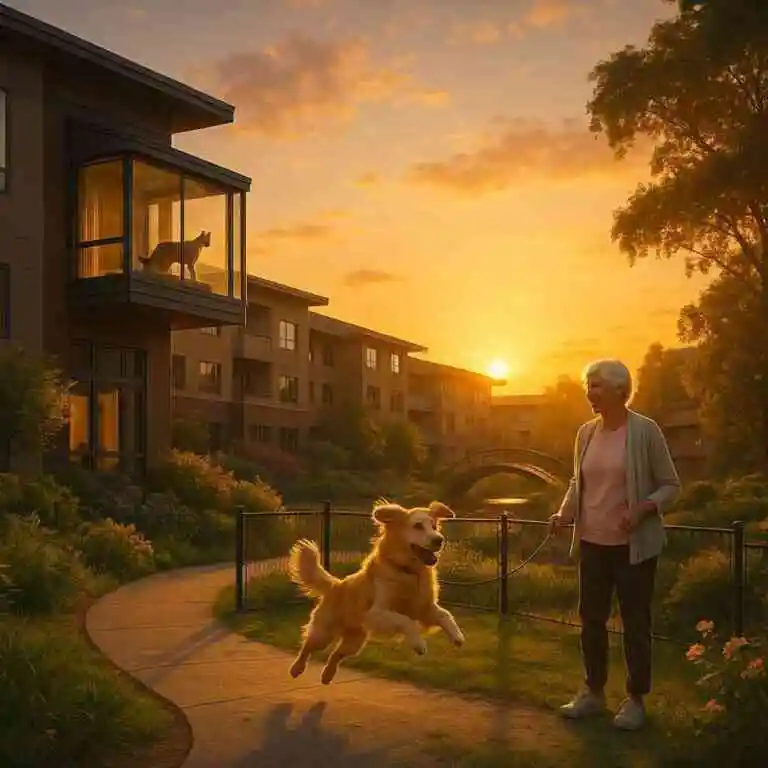
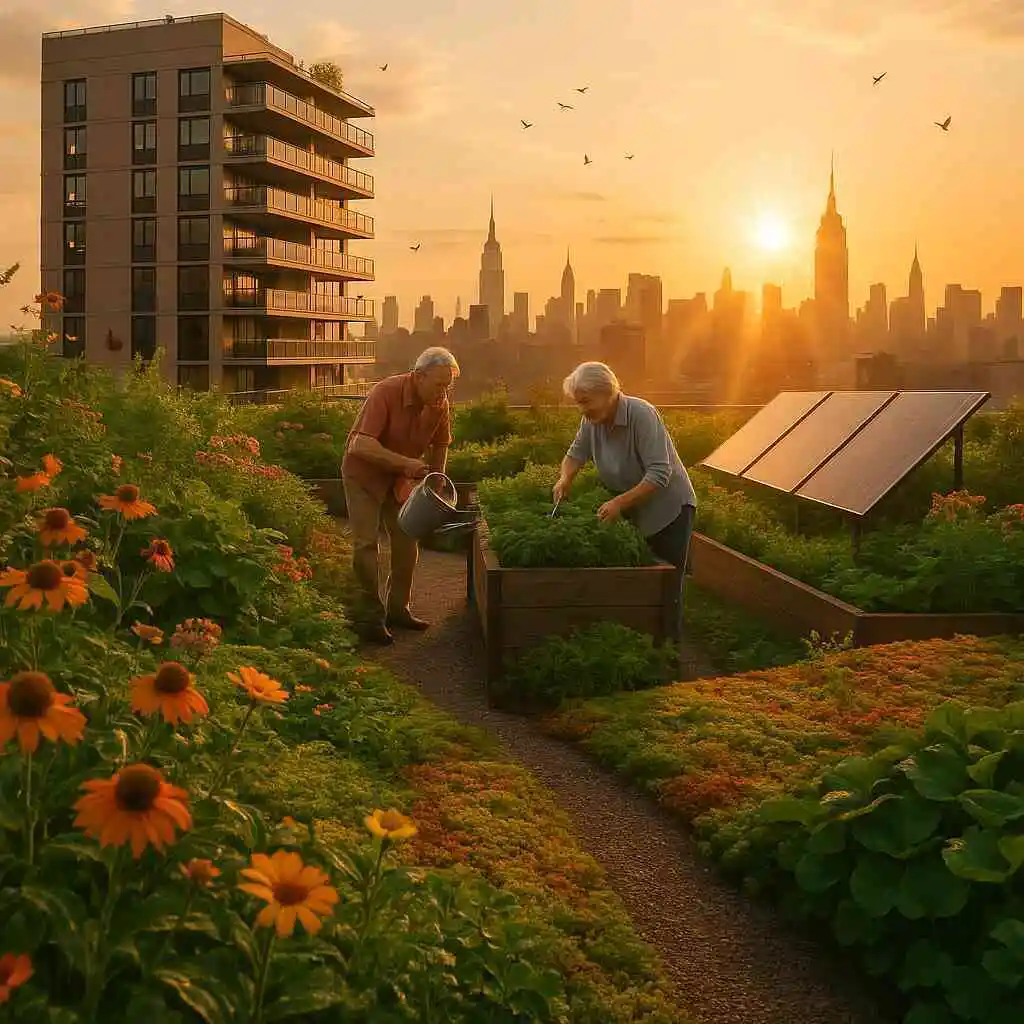
Concrete towers no longer define elder care horizons. Across borough skylines, rooftop meadows and orchards increasingly crown New York senior living facilities with green roofs. Developers now chase foliage because residents seek life, light, and fresh air overhead. Sustainable senior housing in NYC harnesses biophilic design to reconnect older adults with seasonal rhythms. The living roof becomes both insulation and inspiration. It moderates temperature indoors while offering aromatic herbs steps from elevators. These multifunctional layers meet city sustainability mandates yet, more importantly, cultivate dignity. Residents sow seeds, harvest tomatoes, or simply watch butterflies visiting milkweed. That daily interaction nurtures mental health and extends mobility routines. Therefore rooftops evolve into wellness destinations rather than sterile utility zones. New York’s density, once a barrier, becomes an opportunity to stack nature above noise. Green roofs transform passive shelter into an active sanctuary.
Policy and preference converge to accelerate the shift. Local Law incentives reward developers for stormwater retention and energy savings. Simultaneously, families searching for housing options for seniors demand clear climate commitments. Eco-conscious assisted living communities leverage green roofs as proof of action, not rhetoric. Marketing photographs of residents tending pollinator beds resonates more than charts about insulation values. Hospitals also refer patients to buildings showing lower allergen loads after vegetation installation. Thus, rehabilitation pipelines increasingly feed into rooftop garden addresses. The competitive landscape now treats verdant decks as essential amenities, similar to gyms. Operators without foliage risk vacancy and rising energy bills. Conversely, those embracing plants witness higher occupancy and enthusiastic word-of-mouth. The upward trend shows no sign of slowing.
Urban heat island reduction as a new standard for senior living near me
Summer heat strikes hardest where asphalt dominates. Seniors, whose thermoregulation weakens, face elevated hospitalization rates during heat waves. Green roofing counters the urban heat island by lowering surface temperatures dramatically. Leaf transpiration and moist soil absorb solar radiation, protecting interior common areas. Research shows rooftop vegetation can reduce peak temperatures by thirty degrees Fahrenheit. Consequently, energy use for cooling drops, delivering immediate financial relief to operators. Residents feel comfortable walking corridors rather than retreating to air-conditioned rooms. Staff safety improves, limiting turnover linked to overheated work environments. Insurance carriers notice reduced risk, sometimes offering premium discounts. Therefore, thermal resilience is becoming a baseline expectation for any new senior living near me.
Families scrolling digital listings place “cool, shaded spaces” among top search filters. Senior Living Facilities meets that need by letting users quickly find climate-friendly senior living near you. The platform’s icon system highlights properties reporting heat island reduction metrics. By clicking the feature, caregivers compare kilowatt savings, roof depth, and plant diversity. Such transparent data turns abstract sustainability claims into measurable value. Decision makers appreciate seeing both comfort scores and assisted living plans on the same dashboard. Transparency fosters trust, encouraging earlier move-in commitments. Operators notice shorter sales cycles when environmental performance appears upfront. Thus, digital discovery tools and rooftop science reinforce one another. Together they redefine comfort standards for older New Yorkers.
Alignment with Senior Living Facilities’ nationwide search and compare tools
While rooftops capture imaginations, effective adoption requires coordination beyond architecture. Senior Living Facilities acts as a nationwide senior living locator translating rooftop innovation into searchable criteria. Its database spans independent living community listings, assisted living locations, and nursing homes for the elderly. Each profile now includes a sustainability tab detailing substrate depth, plant palette, and photovoltaic integration. Families comparing rental housing for seniors can therefore weigh eco amenities against traditional metrics like care levels. That side-by-side view democratizes information previously locked in marketing brochures. Operators welcome the standardized format because it highlights their investments in plain language. Investors also monitor listings to gauge which properties meet emerging green bond requirements. The platform effectively bridges architects, caregivers, and financiers. This alignment accelerates market shifts toward climate-resilient housing options for seniors without raising search complexity.
Moreover, the search engine’s filters extend beyond the city. Families relocating from Brooklyn to Buffalo can preview comparable living roofs statewide. The same interface shows carbon-neutral retirement communities in New York suburbs or upstate villages. Cross-state relatives may compare these against sustainable assisted living in New Jersey and eco-amenity senior residences in Connecticut. By centralizing data, Senior Living Facilities reduce hours spent juggling brochures, phone calls, and PDFs. The clarity encourages earlier conversations about aging in place, often before a health crisis. Early planning delivers better outcomes for residents and caregivers alike. Consequently, the platform’s influence stretches well beyond its digital boundaries. It shapes construction pipelines, regulatory discussions, and resident expectations. As each green roof opens, the database grows, feeding a virtuous cycle of transparency and innovation.
Biophilic Engineering Meets Everyday Care
Integrating therapeutic rooftop gardens for seniors into assisted living plans
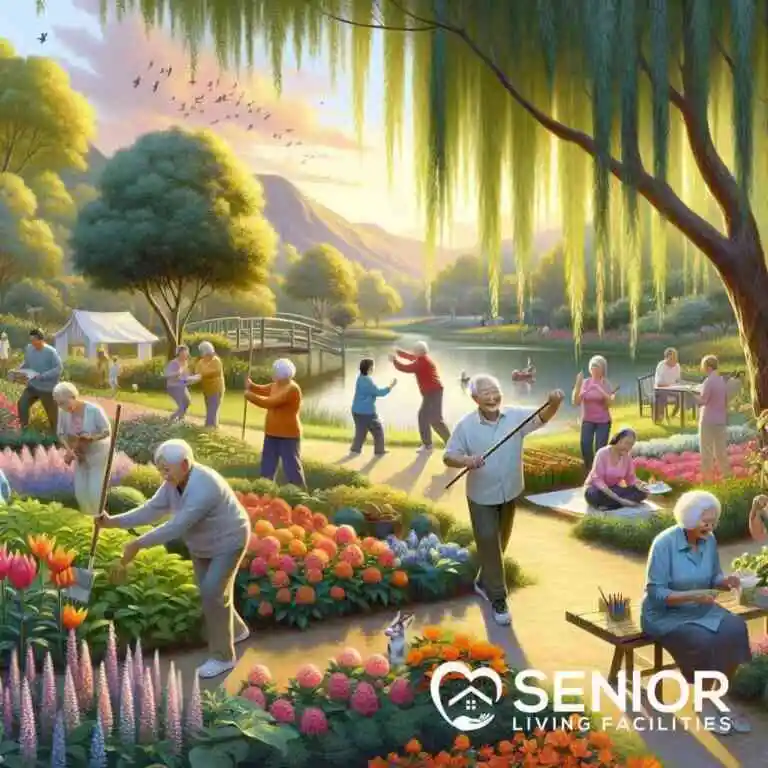
Therapeutic rooftop gardens for seniors transform routine care into multisensory engagement. Raised planters position basil and marigolds at wheelchair height, encouraging independent reach and smell. Paved looping paths invite steady walking practice without stair barriers. Care teams weave gardening tasks into the daily activities of living, replacing passive television time. Consequently, residents report improved appetite, mood, and social connection.
Assisted living plans increasingly list “morning garden rounds” alongside medication reminders. Occupational therapists use seed sowing to refine fine-motor strength, while speech therapists spark conversation about plant memories. Small-group planting circles foster friendships across cultural backgrounds. Family members notice the difference, describing evenings that feel more purposeful. That emotional lift supports longer stays and lower hospital readmission rates.
Program designers study data from campuses showcasing wellness innovation through therapeutic roof spaces to refine staffing ratios. Insights highlight how a single horticultural coordinator can guide twenty residents per session. The platform’s case studies outline soil depths, adaptive tools, and harvest calendars. Administrators download templates, then tailor them to local microclimates. By following proven models, every senior living facility can cultivate vibrant sky-level sanctuaries.
Stormwater-managing green roofs at nursing homes for the elderly
Stormwater-managing green roofs guard vulnerable elders against flooding that can shut down elevators and therapy gyms. Thick substrates retain inches of rainfall, releasing water slowly into drainage systems. That moderation prevents street surges that historically threatened basement medical storage. Lower runoff also helps nursing homes meet municipal discharge limits, avoiding costly fines. Residents remain calm knowing power and safety stay uninterrupted.
Botanical engineers select sedum, ajuga, and swamp milkweed to maximize absorption while feeding migrating pollinators. Modular trays simplify installation above existing membrane layers, keeping construction noise minimal. Maintenance crews inspect drains quarterly, logging metrics for regulatory reports. Many facilities publish those numbers on bulletin boards, turning infrastructure into conversation starters. Elders proudly track gallons saved like grandchildren tallying school fundraisers.
Decision makers compare project blueprints while reading what green design means in elder care settings. The resource explains permitting pathways, warranty clauses, and staff training tips. Administrators share links with board members before budget votes. Transparent education accelerates adoption, especially when paired with visual tours of blooming rooftop wetlands. In turn, each completed roof strengthens community resilience and marketing appeal.
Photovoltaic green roof synergy powering energy-efficient senior apartment rentals
Pairing photovoltaic arrays with vegetation delivers the best of shade and solar. Panels elevate above plantings, allowing airflow that cools circuitry and boosts output. Meanwhile, foliage under the panels stays moist, reducing heat that might otherwise degrade membranes. The dual system slashes utility bills, important for fixed-income renters. Savings lets operators freeze monthly fees longer, easing family budgeting.
Financial models show break-even timelines dropping below seven years when state incentives stack with federal credits. Energy dashboards in lobbies display real-time watt production. Residents enjoy seeing daisies under gleaming panels while knowing elevators run on sunshine. Eco-conscious grandchildren proudly share photos on social media, amplifying word-of-mouth marketing. Occupancy rates climb, reinforcing the value of early investment.
Regional comparisons become effortless through listings of energy-efficient retirement communities in Pennsylvania and neighboring states. Families benchmark kilowatt usage before touring New York buildings. Competitive data encourages operators to refine shading angles or battery storage capacities. Healthy rivalry pushes the entire sector toward net-zero goals. Seniors ultimately benefit from quieter, cleaner, and more affordable homes.
Adaptive reuse senior housing with living roofs across Brooklyn, Queens and beyond
Vacant warehouses and former schools now sprout rooftop meadows, becoming coveted adaptive reuse senior housing. Exposed brick halls meet contemporary HVAC systems, achieving charm without compromising comfort. Architects reinforce joists to bear soil loads, then invite residents to choose seasonal blooms. Community art projects paint old elevator doors with botanical motifs mirroring rooftop beds. History merges with horticulture, creating identity for each floor.
In Brooklyn, rooftop pergolas provide shade against harbor breezes, while Queens senior living community courtyards host tai chi at sunrise. Transportation savings follow, since many revived buildings sit near subway lines. Grandchildren visit more often when travel feels effortless, weaving elders into family routines. Urban planners note reduced greenhouse gas emissions through preserved embodied carbon.
Families browsing green roof senior living options in New York admire before-and-after photos of these transformations. The filter showcases skylight retrofits, accessible rooftop ramps, and pollinator counts. Transparent metrics demystify structural upgrades that once looked daunting. As success stories multiply, developers scout additional underused sites, ensuring every borough gains eco-amenity rich senior living near you.
LEED certified long term care facility design pathways
Achieving LEED certification demands integrative planning from blueprint to post-occupancy monitoring. Teams align envelope insulation, low-VOC finishes, and renewable energy to earn points. Green roofs contribute across several categories, from stormwater capture to heat island reduction. Certification symbols at entryways reassure families that sustainability claims undergo third-party scrutiny. Staff retention also improves when employees breathe cleaner indoor air.
Operators start by commissioning energy models that show potential scoring gaps. Material procurement teams prioritize regional suppliers, shortening transport distances. Construction managers schedule noise-sensitive tasks around resident therapy sessions. After opening, facility dashboards track water use, waste diversion, and biodiversity indices. Continuous feedback satisfies LEED maintenance obligations while guiding future upgrades.
Executives follow industry insights on biophilic senior housing to stay ahead of evolving standards. Articles decode acronyms, spotlight grant programs, and profile peer achievements. Networking events hosted by Senior Living Facilities match leaders with consultants who secured Platinum plaques. Knowledge sharing propels the entire ecosystem forward, ensuring tomorrow’s elders thrive in regenerative environments.
 Resilience and Wellness on the Roof
 Resilience and Wellness on the Roof
Horticultural therapy programs that nurture cognition and mobility
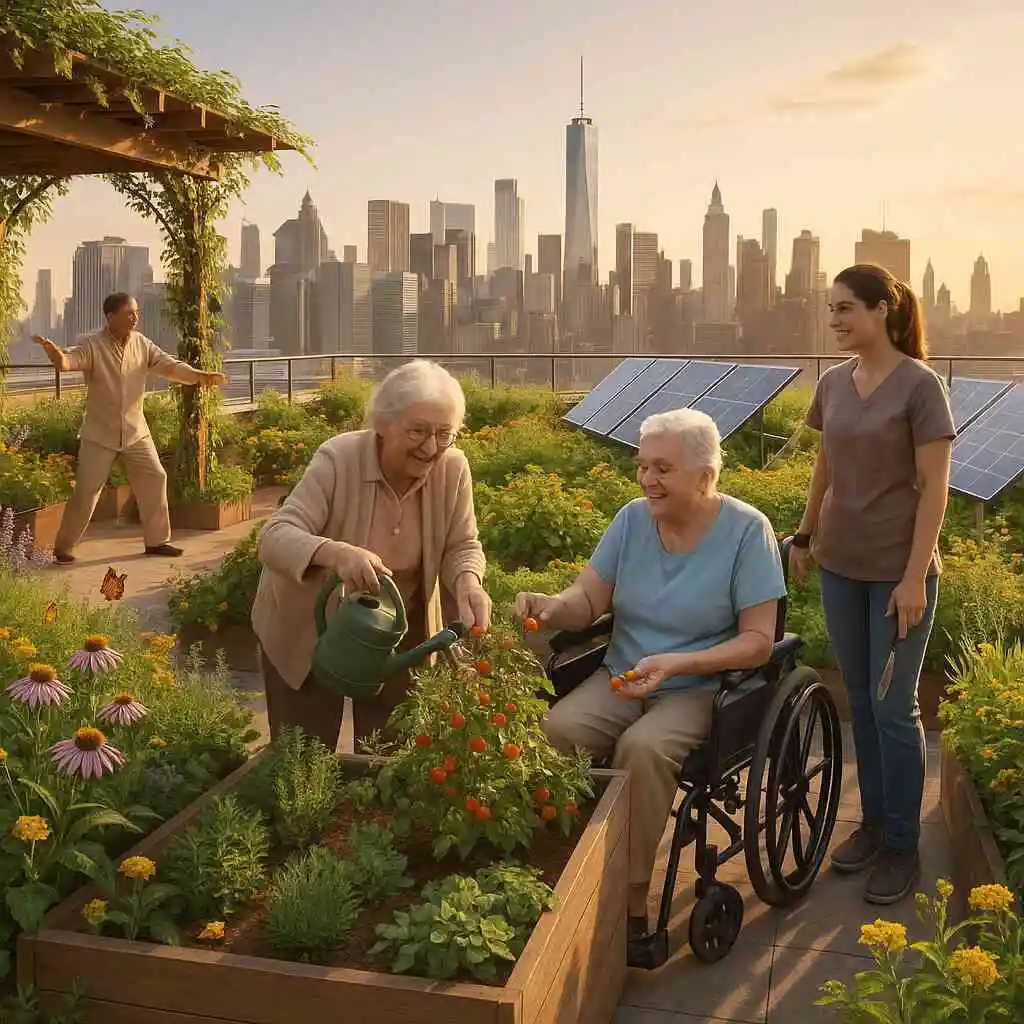
Rooftop gardens at every forward-thinking senior living facility now double as therapeutic classrooms. Residents plant lavender, pinch basil, and track sprouting beans, all while strengthening fine-motor control. Occupational therapists fold these sensory tasks into daily care plans, turning repetitive exercises into meaningful moments. Research shows soil contact triggers memory recall, so gardeners often reminisce about childhood farms or window boxes. Those conversations boost verbal fluency and reduce isolation, nurturing both brain health and community spirit.
Consistent programs also improve lower-body strength. Carefully graded paths encourage deliberate walking that reduces fall risk. Raised planters positioned at wheelchair height support inclusive participation, ensuring no resident feels sidelined. Weekly harvest celebrations give purpose, sparking anticipatory joy and reinforcing routines. Families notice grandparents returning indoors energized rather than fatigued. This vitality illustrates how fostering daily purpose on urban green roofs directly elevates quality of life.
Climate resilient housing options for seniors through carbon-neutral systems
Green roofs unite with solar arrays to form carbon-neutral canopies shielding New York senior housing. Photovoltaic panels hover above sedum carpets, sharing sunlight while cooling circuits. Captured energy powers elevators, kitchens, and medical equipment, buffering residents from grid instability. At the same time, thick soil layers absorb stormwater, keeping basements dry and maintenance costs predictable. Combined technologies create climate resilient housing options for seniors that outperform traditional insulation alone.
Financial sustainability follows environmental gains. Utility savings let operators hold rental housing for seniors at stable rates despite market swings. That predictability matters when fixed incomes meet rising expenses. Facilities that achieve net-zero status proudly showcase dashboards in lobbies, turning abstract kilowatts into daily talking points. Forward-looking owners often decide to list your carbon-neutral senior facility on Senior Living Facilities, signaling transparency to eco-minded families comparing options.
Intergenerational green spaces in communities for seniors 55 plus
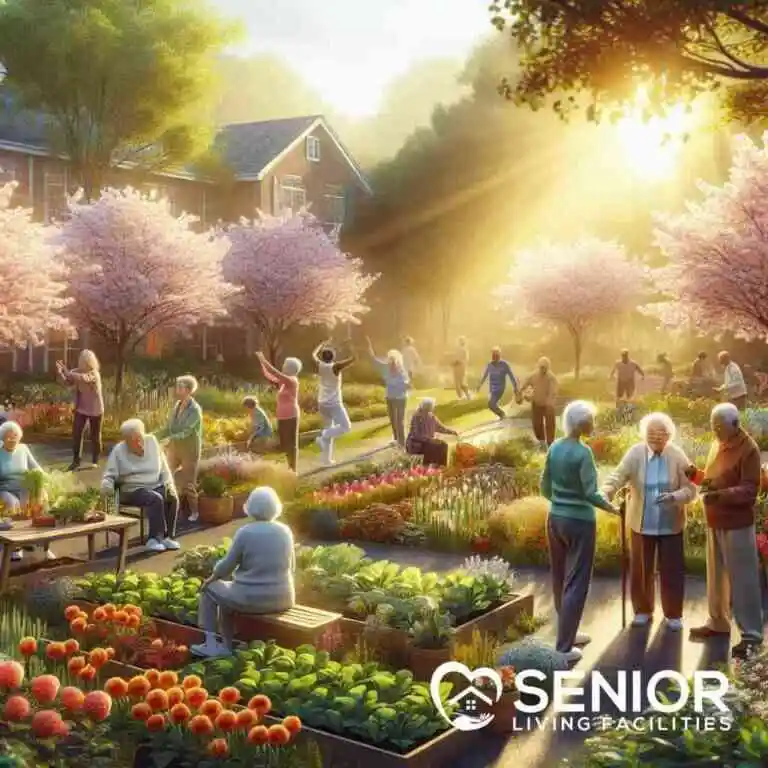
Nothing sparks laughter faster than toddlers chasing butterflies through rooftop meadows. Communities for seniors 55+ increasingly schedule preschool visits and family cookouts on rooftop terraces. Modular seating allows elders to rest while still supervising play, creating natural mentorship moments. Planting beds labeled in multiple languages invites grandchildren to practice reading aloud. These small design choices transform passive observation into shared discovery and collective pride.
Program directors document improved mental health scores when multiple generations mingle consistently. Younger visitors gain respect for aging, while older adults feel valued for storytelling expertise. Rooftop movie nights project classics onto whitewashed elevator shafts, attracting neighbors across age brackets. Such inclusive events prove that intergenerational life in 55 plus roof gardens is more than a catchphrase; it is a replicable blueprint for vibrant urban living.
Enhancing social connection through wellness centered roof landscapes
Social wellness thrives where design encourages spontaneous hellos. Curved walking loops guide residents past herb stations, bird baths, and shaded benches, prompting organic conversation. Staff schedule morning tai chi classes, yet many friendships blossom during unplanned sunset visits. The aroma of mint or the sight of monarchs becomes an effortless icebreaker, crucial in combating loneliness among older adults.
Senior Living Facilities, the national hub for eco-conscious senior housing searches, now tags listings that document measurable social engagement improvements. Families scanning for “senior living near me” appreciate metrics like resident event attendance and volunteer hours. Transparent data reassures caregivers that promised amenities translate into lived experience. As trust grows, move-in timelines shorten, benefiting both operators and seniors seeking community belonging.
Urban biodiversity habitats supporting pollinators and people alike
Every square foot of rooftop greenery contributes to a larger ecological tapestry across the city. Milkweed patches host monarch larvae, and blooming echinacea feeds migratory bees. By choosing native plants, facility gardeners support declining pollinator populations while reducing irrigation demands. Residents track species sightings on communal boards, turning citizen science into a hobby that stimulates cognition.
Biodiverse roofs also capture airborne particulates, improving respiratory comfort inside adjacent common rooms. That cleaner air decreases medical visits related to asthma or allergies, enhancing overall wellness. Neighborhood schools sometimes partner for science lessons, giving elders an audience for wisdom and reinforcing intergenerational ties. Through purposeful planting and stewardship, senior living facilities prove that urban aging and environmental restoration can flourish together.
The Financial and Operational Blueprint for Eco-Minded Facilities
Funding routes from incentives to green bonds for senior living facilities
Municipal abatement programs now refund installation fees when a New York senior living facility commits roof space to vegetation. Energy rebates layer on top of stormwater credits, shortening payback timelines and freeing cash for resident wellness programs. Forward-thinking operators also issue green bonds, attracting impact investors who appreciate predictable rental income from senior housing. Because these instruments demand verified environmental outcomes, vegetated roofs and solar arrays become essential, measurable assets rather than aesthetic extras. Families feel reassured knowing their loved ones live in buildings backed by transparent, accountable financing.
Community Development Financial Institutions further reduce borrowing costs when projects promise affordable rental housing for seniors alongside climate resilience. Grants from state clean-energy funds cover feasibility studies, while philanthropic donors often underwrite rooftop horticultural therapy areas. Administrators who want tailored guidance simply contact experts on sustainable senior living before finalizing capital stacks. That early consultation prevents costly redesigns and aligns documentation with agency benchmarks. In practice, layered funding lets even modest nonprofits compete with larger corporate providers while still delivering standout eco amenities.
Lifecycle cost savings and ROI of energy efficient senior apartment rentals
Operational spreadsheets reveal the magic quickly. After installation, green roofs slash summer cooling loads and reduce winter heat loss, stabilizing utility bills for energy-efficient senior apartment rentals. Insurance premiums also dip because rooftop vegetation lowers fire risk and extends membrane lifespan. When owners calculate total lifecycle costs, systems that once looked expensive often outperform traditional ballast roofs within eight years. Those savings compound across decades, strengthening reserves for future resident services.
Return on investment expands beyond spreadsheets. Eco-conscious assisted living communities gain free publicity, higher occupancy, and longer average lengths of stay. Prospects scrolling “senior living near me” listings note lower fees tied to reduced energy overhead, then book tours sooner. Market analysts now list rooftop gardens among the top design drivers shaping the rooftop gardens by 2026. Consequently, facilities embracing biophilic engineering enjoy both stronger cash flow and undeniable brand lift.
Maintenance strategies for green roof longevity in a long term care facility
Long-term care facility executives understand that a thriving roofscape requires disciplined stewardship. Quarterly inspections verify membrane integrity, clear drains, and calibrate moisture sensors, keeping vegetation healthy without excessive watering. Integrated pest management replaces harsh chemicals, protecting frail immune systems inside adjacent rehab suites. Trained horticultural aides coordinate with nursing staff, ensuring resident planting sessions do not conflict with medication rounds. These synchronized workflows keep operating budgets predictable and gardens consistently lush.
Technology further simplifies upkeep. Lightweight robots now map soil moisture, flagging dry patches before plants wilt or substrates erode. Data dashboards integrate with building management systems, allowing facility engineers to track roofs alongside HVAC metrics. Over time, predictive analytics schedule maintenance precisely when crews already handle other rooftop equipment, minimizing labor costs. Such foresight cements sustainability goals while honoring the health priorities that define quality elder care.
Sustainability focused senior living locator searches are driving occupancy rates
Digital discovery patterns have shifted. Families start by typing “eco-amenity rich senior living near you” and filtering for measurable roof green-space data. Senior Living Facilities meet that demand by spotlighting stormwater retention numbers, native plant counts, and kilowatt offsets. Properties that display strong metrics rise in search rankings, earning more clicks and earlier tour bookings. Higher visibility translates into faster lease-up and consistent waiting lists, protecting revenue even during challenging markets.
Resident satisfaction follows the same arc. Surveys show that seniors value daily access to fresh air and pollinator gardens as much as dining options. Word of mouth spreads quickly when grandkids share photos of rooftop butterfly releases. Operators who previously struggled with vacancy now celebrate full occupancy and reduced marketing spend. Sustainable search criteria are no longer a niche filter; they are the baseline expectation across every major metropolitan region.
Partnership models with local universities for ongoing research and training
Universities across New York City eagerly collaborate with senior living facilities to monitor plant health, stormwater performance, and resident well-being. Environmental science departments install sensors, while gerontology students interview gardeners about mobility gains. These projects generate peer-reviewed data that strengthens grant applications and sharpens design guidelines. Meanwhile, residents enjoy the intellectual stimulation of meeting researchers and attending rooftop workshops.
Training pipelines emerge in parallel. Horticulture scholars complete practicums by leading seasonal planting sessions, then graduate into full-time roles within communities for seniors 55+. Nursing students learn to integrate outdoor activity into care plans, ensuring future clinicians champion biophilic design. Through such partnerships, eco-minded buildings become living laboratories, continuously refining best practices while enriching resident life.
From Rooftop Seed to Community Legacy
 From Rooftop Seed to Community Legacy
Scaling the movement to every borough and every Senior Living Facilities listing
Green roofs began as bold experiments atop one New York senior living facility, yet the trend gained speed quickly. Developers in every borough now consult Senior Living Facilities before breaking ground, ensuring designs meet resident needs and climate goals. Listings across Staten Island, the Bronx, and Midtown showcase soil depths, biodiversity counts, and accessible ramps in clear language. Families browsing senior living near me appreciate seeing comparable metrics, whether touring luxury towers or modest rental housing for seniors. Because information flows freely, no borough feels left behind in the green skyward march.
Data transparency drives further adoption. Operators notice that communities for seniors 55+ featuring living roofs reach full occupancy sooner than traditional high-rises. Each successful project encourages the next, turning rooftops into visual proof of environmental stewardship. Cross-state comparisons with eco-amenity senior residences in Connecticut inspire friendly rivalry, pushing designers to refine pollinator habitats and stormwater capture rates. The Senior Living Facilities database records these improvements, giving caregivers confidence in every listing. Momentum thus becomes self-sustaining, lifting standards citywide while strengthening brand trust.
The future of aging in place in New York through biophilic design
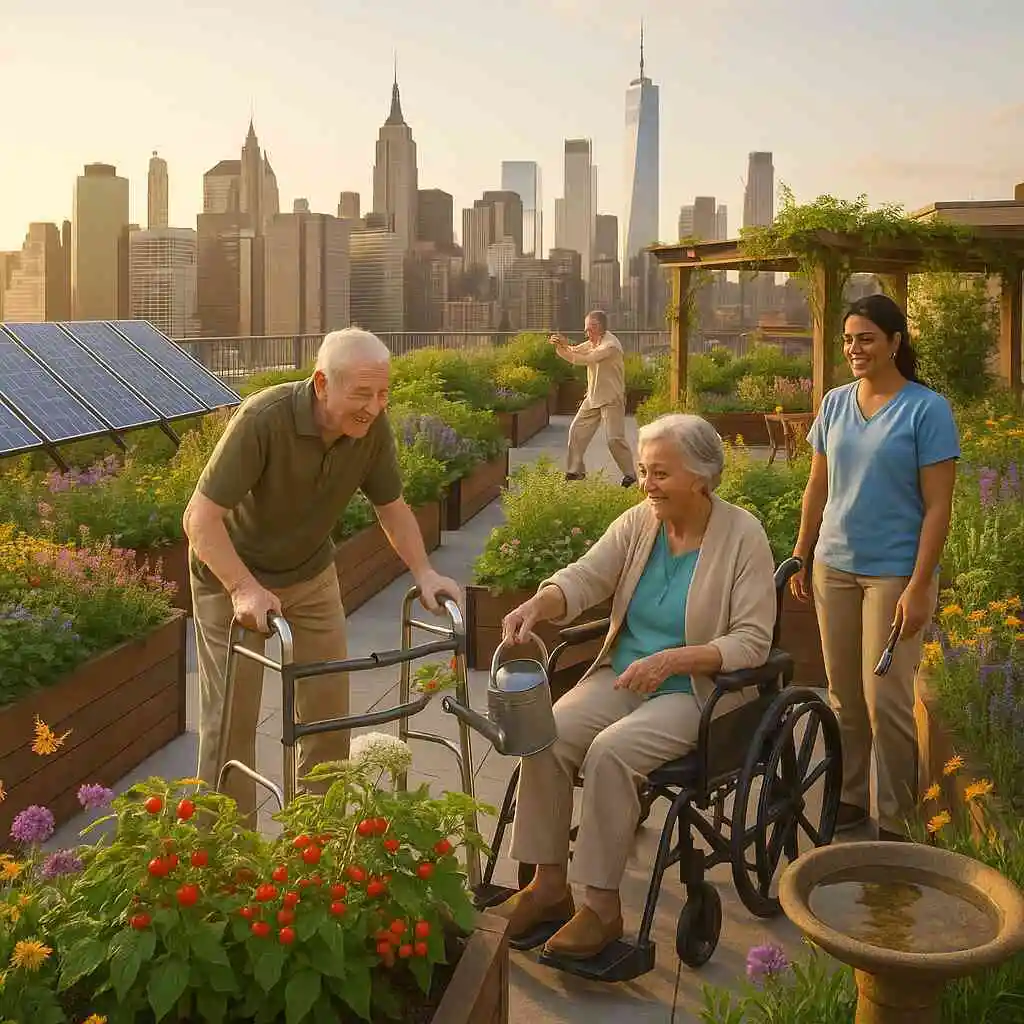
Aging in place once meant remaining in a private apartment, yet today it also means staying connected to nature. Biophilic roof landscapes deliver that connection without requiring long trips to distant parks. Residents cultivate herbs, track migrating butterflies, and share harvests in communal kitchens, all within elevator reach. Such daily engagement supports activities of daily living in eldercare by promoting strength, coordination, and purpose. As care teams witness these gains, they weave rooftop sessions into assisted living plans, redefining best practice.
Technological advances will deepen the impact. Moisture sensors, lightweight solar panels, and modular planters simplify maintenance, letting even smaller senior housing budgets join the movement. Predictive analytics schedules caretaking tasks, ensuring lush growth year-round. By pairing technology with nature, senior living in the state of New York positions elders as stewards of environmental resilience. Future residents will not just occupy buildings; they will co-create vibrant ecosystems overhead. That participatory model sits at the heart of tomorrow’s housing options for seniors.
Inviting families to envision an eco amenity rich senior living community near you
Choosing a senior living facility can feel overwhelming, yet rooftop gardens turn abstract brochures into a tangible promise. Imagine grandparents leading grandchildren along blooming sedum paths, sharing stories beside solar-powered fountains. Those images demonstrate how wellness-centered roof landscapes nurture social bonds alongside energy savings. Senior Living Facilities’ assisted living locator filters highlight such amenities instantly, shortening the search journey for time-pressed families. Clear icons reveal which senior apartment rentals deliver carbon-neutral power, pollinator habitats, and shaded exercise loops.
A simple next step awaits. Enter your zip code, compare senior living near you, and schedule a rooftop tour that suits specific care levels. Whether seeking independent senior living lifestyle freedom or comprehensive nursing homes for the elderly support, the platform aligns eco priorities with personal needs. Your choice influences market demand, encouraging more developers to plant seeds overhead. Together, residents, families, and providers can transform every city block into a greener, healthier network of senior living facilities.
Frequently Asked Questions
Question: How do green roofs at New York senior living facilities enhance resident wellness while tackling the urban heat-island effect?
Answer: Vegetated rooftops lower surface temperatures by as much as 30 °F, shielding older adults whose bodies regulate heat less efficiently. The cooling effect cuts air-conditioning costs, keeps corridors comfortable for mobility routines, and reduces staff fatigue. At the same time, residents gain daily access to fresh air, fragrant herbs, and pollinator activity-proven boosters of mood, appetite, and social engagement. By choosing a New York senior living facility with a green roof, families secure both climate resilience and a built-in wellness program for their loved ones.
Question: Which eco amenities can I filter for when I search senior living near me on SeniorLivingFacilities.com?
Answer: The platform lets you sort listings by heat-island reduction scores, stormwater retention capacity, photovoltaic green-roof integration, native plant biodiversity, and horticultural therapy programming. Whether you need independent living, assisted living locations, or nursing homes for the elderly, a single dashboard compares kilowatt savings, LEED status, and rooftop accessibility. Transparent data ensures you find sustainable senior housing in NYC-or anywhere in the 50 states-that aligns with care level and budget.
Question: How does the blog Senior Living Facilities New York Integrate Green Roofs relate to aging-in-place apartments and therapeutic rooftop gardens for seniors?
Answer: The blog illustrates real-world examples of biophilic design in senior living-raised planters at wheelchair height, looping walkways for gait training, and morning garden rounds woven into assisted living plans. These features turn aging-in-place apartments into multisensory sanctuaries that strengthen cognition and mobility. Senior Living Facilities catalogs every community that adopts such rooftop programs, making it easy to locate housing options for seniors that deliver purpose-filled days alongside professional care.
Question: Can I find LEED-certified long-term care facilities with photovoltaic green roof integration through your assisted living locator in the state of New York?
Answer: Absolutely. Our database tags each LEED-certified long-term care facility and flags whether its roof pairs vegetation with solar panels for carbon-neutral power. Search Senior Living in New York, filter by renewable energy and LEED status, and you’ll see real-time watt production and payback timelines. These energy-efficient senior apartment rentals often benefit from lower utility fees, predictable monthly costs, and third-party-verified sustainability key factors for eco-conscious families.
Question: What maintenance and funding strategies should operators consider for a stormwater managing green roof at a senior living facility?
Answer: Quarterly inspections, moisture sensors, and integrated pest management keep vegetation healthy without disrupting resident care schedules. Operators can layer New York City stormwater credits, state renewable-energy rebates, and green-bond financing to shorten ROI to under eight years. Publishing performance metrics-gallons retained, kilowatts generated-builds resident pride and boosts marketing appeal. Senior Living Facilities offers free consultations and showcases best-practice case studies so every community can sustain a thriving rooftop ecosystem.
Admin
Expert contributor specializing in senior living care. Dedicated to providing families with clear, actionable advice.