Top 7 Questions to Ask Before Touring Senior Facilities
1) The one question that exposes whether a senior facility actually fits your family
You may be tired, worried, and slightly overwhelmed already. That is normal. Tours can sound polished while the real daily experience stays hidden. The most important question is simple: What does a typical day really look like here for someone who needs more help than they admit? That question cuts through brochures, sales language, and cheerful lobby talk. It shows whether the place fits the person, not just the category.
What the daily rhythm feels like for someone who needs more help than they admit
Ask about mornings, meals, medication help, and the quiet hours in between. A good senior living community tour checklist should reveal how staff respond when someone is slow to wake, unsteady, or confused. This is where activities of daily living – care and support needs matter more than labels. If Mom needs reminders, cueing, or hands-on help, you need clarity fast. A warm lobby means little if the afternoon feels rushed or lonely.
One family we spoke with toured a place near Tampa that looked perfect on paper. Yet at lunch, the resident next to them could not reach a beverage without help, and nobody noticed. That small moment changed everything. It showed them the gap between marketing and lived reality.
How the tour should reveal the gap between assisted living plans and aging in place
Aging in place sounds comforting, but it is not a care plan by itself. You need to know whether the community truly supports changing needs or simply assumes they will stay stable. Ask how staff adjust [assisted living plans] when mobility, memory, or medication needs increase. If the answer stays vague, keep pressing. Communities for seniors 55+ and 55+ apartments are not the same as a true care setting.
This is also where assisted living differs from plain rental housing. A senior living facility may offer help with daily routines, while a [senior living community] can mean anything from active adult housing to heavier care. In Florida and California, those differences matter even more because local rules and service models vary widely. If you are comparing [senior apartment rentals] or [housing options for seniors], do not assume every option offers support. Ask for the exact level of help in writing.
Why seniors living community language can hide very different levels of care
Here is the part most families miss: words like “community,” “retirement homes,” and “elderly housing” can describe very different realities. Some places are close to [independent living communities], while others operate more like [residential care facilities] or even a [long-term care facility]. You should ask what the staff actually does versus what residents do on their own. That distinction changes everything.
If you are searching for the [best senior living near me], try comparing a few [assisted living locations] through a [senior living directory]. A good [assisted living locator] can help you sort by care level, but your questions still matter most. For families considering [affordable senior living] or [senior living for low-income seniors], the same rule applies. The name on the sign does not tell the whole story. The daily rhythm does.
2) The care question everyone avoids until it matters
Most families ask about care too late. They wait until a fall, a hospital stay, or a scary memory lapse forces the issue. That delay is stressful, and it often narrows choices. So ask this directly: If needs change, can this community still support my loved one without a rushed move? That one question protects you from making a short-term decision that creates a bigger problem later.
How to ask whether the community can handle changing needs without a rushed move
Ask for the community’s process when care needs increase. Do they reassess regularly? Can they help with more medication oversight, mobility support, or behavior changes? The answer should be specific, not soothing. If you hear only “we usually can handle it,” keep asking.
This matters because [assisted living vs nursing home] is not a small distinction. The difference between skilled nursing and assisted living affects services, supervision, and eligibility. A nursing home – long term care setting is built for higher medical needs than [assisted living]. If your loved one may need [skilled nursing facilities] later, you want a provider that explains transitions clearly. You do not want to learn this in a hurry after a crisis.
When independent living communities stop being enough and memory care becomes the safer match
Sometimes the honest answer is that [independent living communities] are no longer enough. If wandering, sundowning, or medication confusion is showing up, ask about [memory care] and [what is memory care]. Families often search [memory care near me] only after the signs become hard to ignore. That search can feel emotional and rushed. Still, it is better to ask now than to guess later.
If the person has Alzheimer’s or another dementia, ask about [Alzheimer’s care facilities] and [dementia care homes]. These settings are built differently from general [senior citizen housing]. They may use secured entrances, structured routines, and specialized staffing patterns. What is memory care and when it becomes the right choice is a useful question to bring into the tour. It helps you match need to setting, not fear to guesswork.
What to listen for when staff explain assisted living vs nursing home and skilled nursing options
Listen for plain language. Good staff can explain [assisted living vs nursing home] without dodging the hard parts. They should be able to describe which residents need help with bathing, transfers, dressing, or more complex medical support. They should also explain when a person may need [Medicare skilled nursing] or a [long-term care facility]. That conversation should feel direct and respectful.
A family in Columbus told us they almost chose the wrong place because every brochure used the same soft language. During the tour, one director finally said, “We can support assistance, but we are not a nursing home.” That honesty saved weeks of stress. It also helped them compare [continuing care retirement community (CCRC)] options with more confidence. Clear care language is never rude. It is a gift.
3) The staff question that tells you more than a polished brochure ever will
Brochures can look wonderful. Staffing tells the truth. If a community looks beautiful but cannot explain who is present, when, and with what training, keep moving. Ask this: Who is actually on site during nights, weekends, and higher-need hours? That is where the real quality shows up.
Who is on site during nights weekends and higher need hours
Do not stop at “we have staff 24/7.” That phrase can mean very different things. Ask how many staff are on duty, what roles they hold, and how quickly they respond to call lights or emergencies. Night coverage matters as much as daytime friendliness. Weekend coverage matters too, especially if family visits are limited.
This question matters in [board and care homes], [residential care facilities], and larger [assisted living locations]. It matters even more in [Texas nursing homes], [Florida senior living], and [California assisted living], where local regulations and staffing models vary. Ask who handles overnight checks, toileting help, and resident concerns. If the answer sounds rehearsed, ask again in plain English. You deserve a real picture.
What to ask about training for dementia care homes board and care homes and residential care facilities
Training is not a buzzword. It should be visible in practice. Ask how staff are trained for dementia behaviors, falls, bathing support, and difficult family conversations. If the community serves memory support residents, ask what specialized preparation they have for [dementia care homes] and [Alzheimer’s care facilities]. Then ask how often refresher training happens.
This is especially important if you are comparing [what is memory care] with standard [assisted living]. Memory support requires more than kindness. It needs routines, redirection skills, and patience under stress. In [board and care homes], staffing may be smaller, which can be good or risky depending on the resident mix. The right question is not “Are you nice?” It is “What are your people trained to do when needs change?”
How to verify staff qualifications without accepting vague reassuring answers
Ask to see the current licensure or staffing verification process. You do not need to interrogate people. You do need to verify what matters. Confirm whether nurses are on site, on call, or available only at certain times. If a community mentions a “senior living advisor” or [senior placement services], ask whether those people are helping with placement only or care decisions too. Clarity helps.
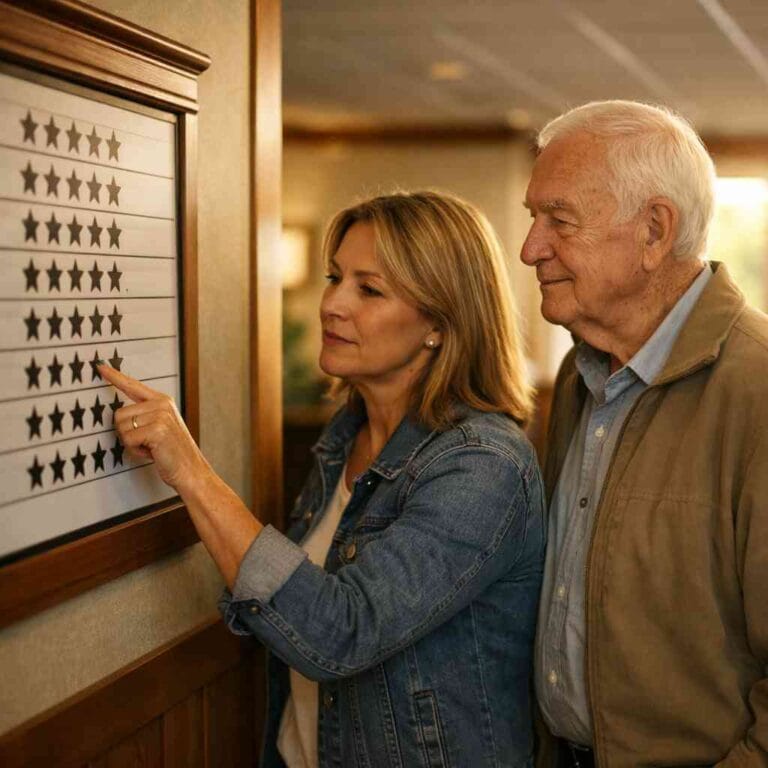
Use outside sources as well. Check state licensing pages, CMS star ratings, and any posted inspection history. The [CMS star ratings for senior housing and nursing homes] are not perfect, but they are useful. They help you compare staffing, inspections, and quality measures. A polished lobby can hide a weak staffing pattern. A careful review cannot.
4) The safety question hidden inside the tour route itself
Safety is not just a policy binder. It is in the hallway width, the lighting, the handrails, and the floor finish under your shoes. Ask this while you walk: Does this route feel safe for someone with balance issues, poor vision, or memory loss? That one question can reveal more than a formal presentation ever will.
How exits hallways lighting and handrails can reveal real fall risk awareness
Look down, then look up. Are there loose rugs, sharp thresholds, or dim corners? Are handrails continuous and easy to grip? Are exits clearly marked without looking confusing? These small details matter because falls are rarely caused by one big mistake. They usually come from a chain of small ones. 
This applies across [elderly housing], [retirement homes], and [assisted living facilities]. If you are considering [independent senior living – active older adult housing], you still want safe walking paths. The same is true for [rental housing for seniors] and [senior apartment rentals]. A building can look elegant and still be hard to move through. Good safety design feels almost invisible.
What to notice in memory care near me searches when wandering prevention matters
If wandering is a concern, a [memory care near me] search should focus on more than distance. Ask how the community prevents elopement, whether doors are secured, and how residents move through shared spaces. In [memory care], wandering prevention is a core design issue, not an afterthought. That is why layout matters so much. Wide-open beauty can be less helpful than calm, predictable structure. If you are comparing memory support in Ohio, New York, or Pennsylvania, ask about outdoor access too. Secure courtyards and visible staff lines can matter a lot. For some families, a community with structured walking paths is a better fit than a flashy campus. You are not choosing decor. You are choosing day-to-day safety. ### Why CMS star ratings state licensing and senior housing regulations should shape your follow up
Safety questions should not end at the tour. Check [senior housing regulations], state licensing records, and the latest [CMS star ratings for senior housing and nursing homes]. These sources help you verify what the brochure cannot. They are especially useful when comparing [best senior living near me] options in high-demand states like Florida and Texas. State oversight is not the whole story, but it is part of it.
If you want more structure, compare notes with [how to choose a nursing home] resources and official inspection summaries. For families weighing [nursing home – long term care setting] options, that follow-up matters. It also helps when a place is marketed as [luxury senior retirement communities] but still has basic safety questions unanswered. Pretty is not enough. Safe is the standard.
5) The money question that can save a family from a painful surprise
Money conversations can feel awkward. They are also necessary. The right question is not just “What does it cost?” It is: What is included, and what gets added later? That question can prevent a painful surprise after move-in day. Families in Scottsdale, Phoenix, Dallas, and suburban Philadelphia ask this all the time.
What the community includes in monthly pricing and what gets added later
Ask for a written list of included services. Then ask what triggers extra charges. Medication reminders, laundry, transportation, personal care, guest meals, and level-of-care changes can all affect the bill. You want the whole picture before anyone signs anything. A verbal promise is not enough.
This is especially important when comparing cost of assisted living against [senior living costs by state]. The national median changes by market, and the [Genworth Cost of Care Survey] is one source families often use for context. If you are comparing [affordable senior living] with [luxury senior retirement communities], the monthly structure can differ a lot. Ask for the fee schedule in writing. Then read it slowly.
How to compare cost of assisted living with long term care facility and nursing home options
Use a side-by-side view. [Assisted living] often covers housing, meals, and support with daily tasks. A [long-term care facility] or [nursing home] usually adds more medical supervision and a different cost structure. Here is a simple comparison:
OptionTypical focusBest forAssisted livingDaily support, meals, and supervisionPeople who need help but not complex nursingNursing homeOngoing medical care and higher supervisionPeople with heavy clinical needsCCRCMultiple care levels on one campusPeople who want transitions without moving farThat table is only a starting point. It is not a substitute for the actual contract. Still, it helps families compare [compare assisted living locations and care levels] without getting lost. If the person may need [Medicare skilled nursing] later, ask how transitions work. The answer matters more than a glossy dining room.
When Medicaid senior housing VA benefits for senior care or long term care insurance may change the conversation
Funding can change the whole search. Ask whether [Medicaid senior housing] is accepted, and whether the community works with [VA benefits for senior care] or [long-term care insurance]. Some families also rely on [senior placement services] or a [free senior living referral] to sort through these details. That support can reduce confusion, especially when a move is urgent.
If you are exploring [affordable senior living options for low income seniors], ask for help early. If your loved one has military service, ask about VA eligibility rules. If you are looking in Florida or California, local programs and state rules can shift the picture. This is where a trusted [senior living advisor] can be practical, not pushy. Money questions deserve calm answers.
6) The lifestyle question that shows whether this place will still feel human after move in
A senior living decision is not only about care. It is about daily life. Meals, pets, quiet spaces, and routine all affect whether a person feels settled or just housed. Ask this: Will this place still feel like a home after the tour glow fades? That question helps you see beyond polished common rooms.
How meals activities pets and quiet spaces affect day to day comfort
Ask to see meal times, not just the dining room. Food quality, timing, and flexibility matter. So do sitting areas, quiet nooks, and whether visitors feel welcome. If your loved one has a pet, ask about [pet-friendly assisted living]. If they value calm, ask where they can sit without constant noise. Comfort is practical.
For some families, these details decide between [independent living communities] and [assisted living]. For others, they matter even more in [continuing care retirement community (CCRC)] settings because residents stay longer. A place can check every medical box and still feel emotionally flat. That is why lifestyle questions belong on the same page as care questions. Human beings need both.
What to ask about senior citizen housing for low income seniors and affordable senior living choices
If budget is tight, ask about [senior citizen housing] options that support dignity without overpromising. [Senior living for low-income seniors] may include subsidies, local housing programs, or communities with income-based models. Ask whether the property has any openings now or a wait process. Ask what documentation they need. Ask what happens if income changes later.
This matters across [communities for seniors 55+] and more supportive settings. [Housing options for seniors] are broad, and [elderly housing] can mean many things. A place can be affordable without feeling institutional. It can also be expensive without feeling especially attentive. Your job is to match the setting to the person, not the label to the budget.
Why senior living with no waitlist luxury senior retirement communities and 55+ apartments are not all the same kind of fit
Quick availability can be tempting. So can the promise of [senior living with no waitlist]. But availability alone does not mean the right fit. [55+ apartments] may offer independence, while [luxury senior retirement communities] may provide a richer lifestyle but different care limits. A fast move is not always the wisest move.
If you are comparing [Florida senior living], [California assisted living], or [Texas nursing homes], ask how waitlists affect care levels. Sometimes the most available option is not the one your loved one truly needs. Sometimes the best option requires patience. That is frustrating, but it is better than moving twice. Good fit beats quick relief.
7) The decision question that turns a tour into a real plan
Tours can pile up quickly. Notes blur. Names blur. Feelings blur too. So ask this final question: How will we compare these places in a way that helps us decide, not just rehash the tour? That question turns confusion into structure.
How to compare assisted living locations side by side without getting overwhelmed
Use a simple scorecard. Compare care, staff, safety, cost, atmosphere, and future flexibility. A [senior living facility comparison] works best when you rank what matters most to your family. If you want a guided process, how to compare senior living facilities in 10 steps can help you organize what you saw. Keep it practical. Keep it honest.
Here is a fast comparison list:
- Care level fit
- Staff visibility
- Safety features
- Monthly clarity
- Lifestyle comfort
- Transition options
You can also compare [assisted living locations] through a [senior living directory]. If one option shines in care but falls short in cost, that matters. If another has better atmosphere but weaker staffing clarity, that matters too. A strong decision is rarely made on one perfect feature. It is made on the best overall fit.
What to do next if the tour points you toward respite care CCRC or senior placement services
Sometimes the tour reveals a different path. Maybe the person needs [respite care] first. Maybe a [CCRC] makes more sense because future care levels are already built in. Maybe the search is better handled with [senior placement services] that can narrow the field. That is not failure. It is useful information.
If memory issues or medical complexity are rising, a what is memory care and when it becomes the right choice conversation may be necessary. If the person is not ready for a permanent move, respite can create breathing room. If the family wants one campus with multiple care levels, a CCRC may be worth exploring. The right next move depends on the person in front of you, not the pressure of the moment.
How a senior living advisor or free senior living referral can help you choose with more confidence
A good [senior living advisor] does not make the decision for you. They help you sort the noise. A [free senior living referral] can save time, especially when you are comparing multiple [assisted living locations] across state lines. That support can be especially helpful if you are dealing with Florida, Texas, or Pennsylvania searches and want a clearer path.
If you want a structured place to start, use top questions to ask before touring senior living facilities and compare it with your notes. Then follow up with the communities that answered clearly. You do not have to figure this out alone, and you do not have to figure it all out today. Start with one call, one tour, and one honest question that matters most.
Frequently Asked Questions
Question: What are the top questions to ask assisted living communities before a tour, and how does Top 7 Questions to Ask Before Touring Senior Facilities help families compare options?
Answer: The most helpful questions focus on daily care, staffing, safety, cost, and future flexibility. Top 7 Questions to Ask Before Touring Senior Facilities is designed to help families move beyond polished brochures and ask what life is really like in a senior living facility. It encourages you to compare assisted living locations, independent living communities, and other housing options for seniors in a way that feels practical and honest. Senior Living Facilities makes that easier by helping you search, compare, and connect with communities across all 50 states, so you can use one checklist to evaluate multiple options side by side.
Question: How can Senior Living Facilities help me find the right seniors living community, assisted living locator, or senior living directory match for my loved one?
Answer: Senior Living Facilities is built to help families find the right fit without guesswork. You can search by location, compare senior living facility options, and review communities for seniors 55+, assisted living locations, rental housing for seniors, senior apartment rentals, and more. Our platform is helpful whether you are looking for affordable senior living, luxury senior retirement communities, pet-friendly assisted living, or senior living with no waitlist. Because every older adult has different needs, we focus on helping you compare care level, lifestyle, and support so you can narrow down the best senior living near me options with more confidence.
Question: What should I ask about care levels, especially if my family is comparing assisted living vs nursing home, memory care near me, or skilled nursing facilities?
Answer: A strong tour should clarify whether the community can support changing needs over time. Ask how the community handles assisted living plans, whether staffing can adapt as care needs increase, and when a move to a long-term care facility or nursing home may be appropriate. If memory loss is part of the picture, ask what is memory care and whether the community offers Alzheimer’s care facilities or dementia care homes. Senior Living Facilities helps families compare assisted living vs nursing home, the difference between skilled nursing and assisted living, and when respite care, CCRC options, or Medicare skilled nursing might be worth exploring. The goal is to match the person’s real needs to the right setting, not just the right label.
Question: How do I compare cost of assisted living, senior living costs by state, Medicaid senior housing, and other payment options without getting overwhelmed?
Answer: Start by asking what is included in monthly pricing and what costs extra later. Then compare the community’s fee structure with your budget, care needs, and possible funding sources such as Medicaid senior housing, VA benefits for senior care, or long-term care insurance. Senior Living Facilities helps families understand how cost of assisted living may differ from a nursing home, board and care homes, or a continuing care retirement community (CCRC). We also encourage families to review broad market context like senior living costs by state and the Genworth Cost of Care Survey, while remembering that local details and contracts matter most. A clear comparison can help you avoid surprises and choose a more sustainable option.
Question: How does Senior Living Facilities support families looking for senior citizen housing, elderly housing, or senior living for low-income seniors?
Answer: We understand that affordability is often one of the biggest concerns in the search for senior citizen housing. Senior Living Facilities helps families explore housing options for seniors across many budgets, including senior living for low-income seniors, affordable senior living, and communities that may fit different financial situations. Depending on the area, that may include senior apartment rentals, 55+ apartments, communities for seniors 55+, or more supportive residential care facilities. Because service areas span all 50 states, families can search for Florida senior living, California assisted living, Texas nursing homes, and more, while staying focused on the support level and setting that best fits their loved one.
Question: Why should I trust Senior Living Facilities when I need help choosing between retirement homes, board and care homes, or a senior living advisor?
Answer: Families often need more than a list of names; they need guidance they can trust. Senior Living Facilities is designed to act as a supportive resource, offering search, compare, and connect tools along with a free senior living referral path for families who want extra help. That can be especially useful when comparing retirement homes, board and care homes, residential care facilities, independent living communities, or assisted living locations. We also encourage families to use practical tools like CMS star ratings, senior housing regulations, and state licensing records when available, so they can verify details and make informed decisions. If you want a more guided search, a senior living advisor or senior placement services partner can help narrow the field, but the final decision always stays with you and your family.
Senior Living Facilities Editorial Team
Expert contributor specializing in senior living care. Dedicated to providing families with clear, actionable advice.