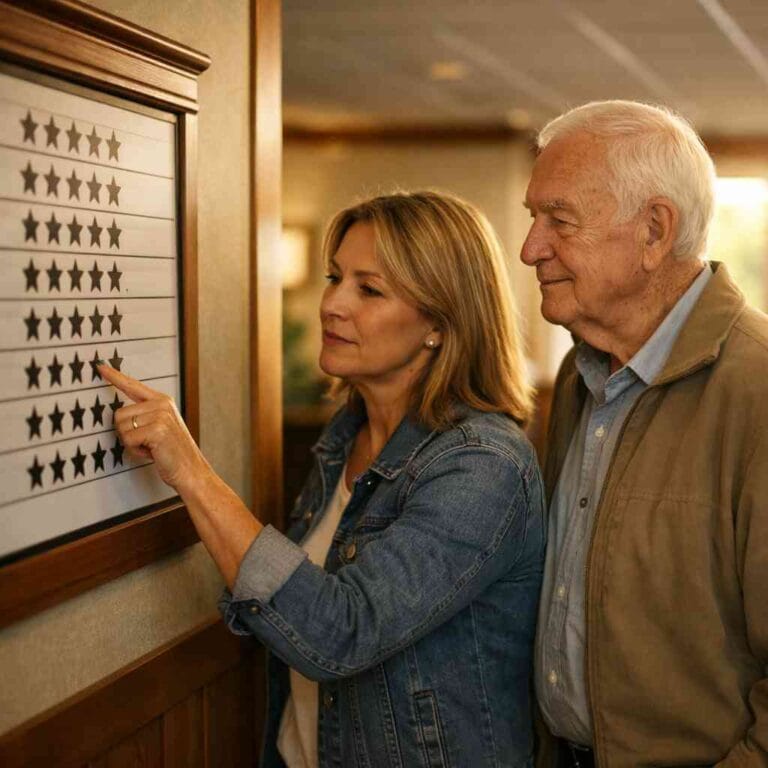
Best 10 Questions About CMS Star Ratings for Senior Homes

What the star rating hides when a beautiful lobby still misses the mark
A polished lobby can calm your nerves quickly. Soft music helps, too. But if you are reading CMS star ratings at midnight, worried about Mom, you need more than a pretty front desk. The question is not whether a senior living facility looks inviting. The real question is whether the care behind the lobby holds up on hard days.
Why CMS star ratings can look reassuring even when family concerns are still unresolved
CMS star ratings for senior homes can feel like a shortcut. They are helpful, but they are not the full story. A facility may look warm and tidy while still having gaps in day-to-day support. That is why families searching for questions about CMS star ratings for senior homes should treat the rating as a starting point, not a verdict. If your loved one has falls, confusion, or complex needs, the details matter more than the stars.
We hear this from families all the time. They walk into a place with fresh flowers and think they are done. Then they learn the staffing pattern does not match what Mom needs at 2 a.m. That is the part most people miss. A star rating can help you compare, but it cannot tell you how a Saturday shift feels for a resident who needs help now.
How health inspection ratings for senior homes differ from staffing ratings in nursing homes and quality measures
Here is where people get tripped up. Health inspection ratings for senior homes come from survey findings, while staffing ratings in nursing homes focus on how much care staff is available. Quality measures in senior care look at resident outcomes and care patterns. Those are different lenses. A place can score well in one area and struggle in another.
Think of it like checking three locks on one door. If one lock sticks, you still need to know. When families use how CMS rates nursing homes or understanding nursing home star ratings, they should compare each category separately. That is how you avoid being misled by a single overall number. In Florida, California, and Texas, state rules can add more context, so always check local licensing pages too.
When a senior living facility quality rating should make you ask more questions instead of fewer
A lower rating does not always mean “no.” Sometimes it means “ask harder questions.” If a senior living facility quality rating drops because of one weak area, you need to know which one and why. Was it inspections? Staffing? Quality measures? That answer changes everything.
One family in Central Florida told us the building looked spotless, almost hotel-like. The inspection notes, though, showed repeated issues with documentation and response times. They asked better questions on the second tour, and the difference was obvious. The staff answered clearly, not defensively. That kind of honesty matters more than a chandelier.
The three ratings that actually shape how CMS rates nursing homes
Most families want one simple score. That is understandable. Still, Medicare nursing home compare does not work that way. CMS builds the overall picture from three core pieces, and each one can shift your decision. If you understand those pieces, the whole system becomes less intimidating.
How Medicare nursing home compare pulls together health inspections, staffing, and quality measures
The CMS system blends three main ratings: inspections, staffing, and quality measures. That is the backbone of what CMS star ratings mean for senior homes. When people use Medicare nursing home compare, they are seeing a snapshot built from survey data and resident-related measures. It is useful because it gives you one place to compare, but it still needs context.
The same logic applies when you are comparing Medicare nursing home compare with local visits. A high overall score helps, but it does not replace a tour. You still need to look at odor, call-light response, tone of voice, and whether residents seem rushed. Those small things tell you a lot.
Why an overall rating for senior homes can be pulled down by one weak category
An overall rating for senior homes can fall fast if one category is weak. That is not a flaw. It is a warning. For example, a place may have strong care routines but a poor inspection history. Or it may have decent inspection results but weak staffing coverage on evenings.
That is why families should not stop at the headline number. An overall score can hide uneven performance across shifts. If you are searching for the difference between skilled nursing and assisted living, this matters even more. Skilled nursing facilities care for more medically complex residents, so the staffing and survey details carry extra weight. A weak category may be manageable, or it may be a red flag. You need the full picture.
What the latest survey cycle can reveal about nursing home inspection results and long-term care facility quality
The newest survey cycle can show a lot. Nursing home inspection results reveal whether problems are repeating or improving. They also show whether a facility corrected past issues on time. That is valuable when you are judging long-term care facility quality.
Here is what almost no online guide mentions. A clean brochure can hide an old pattern. Survey patterns usually do not lie. Families in Texas and California often ask us to help them sort through these reports because the language feels dense and technical. If you use a senior living advisor and senior placement services, ask them to explain the survey history in plain English. You deserve that clarity.
The question families forget to ask about staffing and why it matters
Staffing is where care becomes real. Not in theory. In the hallway, at breakfast, and during the night. If you remember only one thing, remember this: stars do not lift a resident, answer a call bell, or notice confusion before it becomes a fall. People do.
What staffing ratings in nursing homes can and cannot tell you about daily support
Staffing ratings in nursing homes tell you something useful, but not everything. They can show whether the facility meets broad staffing patterns. They cannot fully show whether the team is stable, calm, and attentive on busy shifts. A good ratio on paper may still feel thin in practice.
That is why staffing ratings in nursing homes should trigger a follow-up question. Ask who is on duty at night. Ask how often agency staff fill gaps. Ask whether the same aides work consistently with the same residents. Consistency matters, especially for memory care and rehab support. It lowers stress for everyone.
How to ask whether aides and nurses are consistently present without guessing about qualifications
You do not need to interrogate anyone. You do need to ask clearly. Try simple questions like these:
- How many licensed nurses are on each shift?
- How often do aides rotate?
- What happens if someone calls out?
- Who covers weekends and holidays?
- How are new staff oriented before working alone?
These are smart questions to ask about CMS ratings because they connect the report to real life. Also, verify certifications and licensure through state boards when needed. Do not assume a title tells the whole story. In senior care, details protect people.
Why comparing skilled nursing facilities quality comparison data is only part of the staffing story
A skilled nursing facilities quality comparison chart can help you narrow choices. Still, it is not enough by itself. Staffing quality also depends on morale, turnover, training, and communication across shifts. Those things rarely show up in a single metric.
If you are comparing a long-term care facility in Phoenix, Chicago, or Miami, ask how the staff handles emergencies. Ask who updates families. Ask whether the care plan changes when needs change. Those answers help more than a glossy packet. On the projects we have reviewed this year, the best teams were not always the biggest teams. They were the most consistent teams.
When assisted living starts looking like nursing home care
This is the part that confuses many families. Assisted living and nursing homes sound similar, but they are not the same. The care rules differ. The staffing rules differ. Even the meaning of a “good” rating differs.
How the difference between skilled nursing and assisted living changes what CMS ratings mean
The difference between skilled nursing and assisted living starts with medical intensity. Skilled nursing supports people who need ongoing nursing or rehabilitation. Assisted living focuses more on daily support, meals, supervision, and help with activities. That means CMS nursing home ratings do not translate cleanly to assisted living.
If you are comparing assisted living locations with nursing homes, pause before mixing the two. The quality lens changes. Assisted living plans may include support with bathing, dressing, or medication reminders, but not the same medical coverage as a nursing home. The right choice depends on need, not labels.
What to look for when comparing assisted living locations versus a long-term care facility
When comparing assisted living locations to a long-term care facility, look for the fit between daily needs and daily support. Does the resident need stand-by help, or hands-on transfers? Are there memory concerns? Is there a fall history? Those details shape the decision.
A family in the Bay Area once toured two places in one day. One was a bright assisted living community with cheerful common rooms. The other was a more clinical setting with higher support. Their father needed more supervision than they first realized. The clearer choice came from matching care need, not atmosphere. That is why assisted living vs. nursing home comparisons are so important.
Why assisted living plans and senior living locator searches need a different lens than nursing home reviews
An assisted living locator search should focus on daily life, not CMS stars alone. Look at dining flexibility, fall prevention, medication support, and how the community handles changes in condition. If you are considering affordable senior living, the fit still comes first.
Use this quick mental check:
- Does the community support the current need?
- Can it adapt if care needs increase?
- Does the environment feel calm, not rushed?
- Are family updates clear and regular?
If you are starting with a best senior living near me search, this lens will save time. It will also spare you from touring places that cannot realistically meet the need.
The inspection report details that separate a safe choice from a glossy brochure
Inspection reports can feel heavy. The language is dry. The citations are technical. Still, this is where families often find the most useful clues. A brochure tells you what a community hopes to be. An inspection report tells you what happened when regulators looked closely.
How to read health inspection ratings for senior homes without getting lost in jargon
Start with patterns, not panic. Health inspection ratings for senior homes often reflect the seriousness and frequency of past findings. If a report has repeated medication, falls, or infection-control concerns, pay attention. If the issue was small and corrected quickly, that context matters too.
When people ask about health inspection ratings for senior homes, I tell them to ask three things: what happened, how often, and whether it was fixed. That simple frame cuts through the jargon. It also helps in states with tighter oversight, such as California. Regulations vary, so local reading matters.
Which violations deserve a second look and which ones call for a deeper conversation
Not every citation carries the same weight. Repeated falls without proper intervention deserve a deeper conversation. Medication errors do too. So do infection-control lapses, unexplained weight-loss trends, and poor response to call lights. Those items can affect daily safety.
Some smaller issues may be fixable. Missing paperwork is not ideal, but it is different from unsafe care. The key is pattern and response. If a facility explains the issue clearly and shows correction, that is meaningful. If the answer feels vague, keep asking.
Why senior housing regulations vary by state and can change what families should expect
Senior housing regulations are not uniform. State rules shape staffing, licensing, and reporting expectations. That means what looks normal in one state may not be acceptable in another. Families comparing options in Florida, California, or Texas should always check state agency guidance.
If you are searching for senior citizen housing options or retirement homes, remember this: state rules often define what a place can promise. They also shape what the family can expect. That is why a senior living directory is useful, but local verification still matters. The directory helps you begin. The state rules help you trust the result.
What families should ask when memory care enters the picture
Memory care changes the conversation fast. Safety matters more. Supervision matters more. Consistency matters more. A beautiful setting still matters, but it cannot outweigh wandering risk or confusion after dark. ### How CMS ratings interact with what matters in memory care near me searches 
A search for memory care near me and what to look for should include more than a star rating. CMS data can help if the memory care is part of a nursing home. It will not tell you everything about cueing, redirection, or secured exits. Those are daily care questions.
If you are asking what is memory care and Alzheimer’s care facilities, think in layers. Is the environment easy to follow? Are staff trained to de-escalate? Can they spot changes in behavior early? Those answers matter more than a marketing headline.
Why what is memory care and Alzheimer’s care facilities should be judged beyond the star count
Memory care homes and dementia care homes should be judged on safety design, supervision, and staff response. A star count cannot show whether a resident can wander safely in a courtyard or become confused near a busy dining room. You need to see the layout.
Ask about routines, lighting, and cueing. Ask how they handle resistance to bathing or meals. Ask whether staff receive dementia-specific training. Also ask how families are updated if behavior changes. These questions are practical, not picky.
What to ask about dementia care homes when safety, wandering, and supervision are the real concerns
Wandering risk changes everything. If your loved one is prone to leaving a room or pacing at night, ask direct questions. Is the exit secured? How are residents counted during shift changes? What happens during a power outage? These are not dramatic questions. They are real ones.
For families comparing Alzheimer’s care facilities, the best communities answer plainly. They do not hide behind buzzwords. In Scottsdale and parts of South Florida, memory care communities often lean on enclosed courtyards and simple walking loops. That design choice can reduce stress, but the staff response still matters most.
The money questions behind a star rating that can change the whole decision
Money can make a good option impossible. That is hard, and it is common. You may love the care fit and still need a different answer because the budget is real. The rating matters, but so does the monthly plan.
How cost of assisted living and senior living costs by state fit into a ratings conversation
The cost of assisted living and senior living costs by state should be part of the first conversation, not the last. The cost of assisted living by state can vary a lot. Genworth’s Cost of Care Survey remains a useful reference point for families comparing broad trends. Still, every community sets its own structure, so use local quotes.
If you are comparing senior living facility quality ratings, do not separate them from budget. A better-rated place that strains the family can create pressure later. That pressure can lead to a rushed move. The right choice is one you can sustain.
When Medicaid senior housing Medicare skilled nursing or VA benefits for senior care may matter more than a star count
Sometimes funding changes the decision more than the rating does. Medicaid senior housing can be critical for eligible families. Medicare skilled nursing may cover short-term rehab in specific situations. And VA benefits for senior care can help qualifying veterans and spouses.
If this part feels overwhelming, that is normal. Programs have rules, and the rules are not identical. Families often benefit from checking Medicaid senior housing or VA benefits for senior care early, not after they fall in love with a place. The timing matters. The numbers matter too.
Why long-term care insurance, affordable senior living, and senior living for low-income seniors deserve early attention
Long-term care insurance can change your options. So can grants, state programs, and family support. If you are looking for long-term care insurance for families, review the policy before you assume anything. Coverage rules can be narrow.
Families searching for senior living for low-income seniors should ask about waitlists, subsidy programs, and local housing agencies. In Florida, options can move quickly in some markets, while in California, demand may create longer waits. That is why affordable senior living in Florida is often discussed alongside broader planning. Budget is not separate from care. It is part of care.
The hidden tradeoffs between comfort features and care quality
Comfort features can be wonderful. A pet in the apartment. A quiet courtyard. A waitlist that is not endless. Those things matter. Still, they should never distract you from the care underneath.
Why pet-friendly assisted living, luxury senior retirement communities, and senior living with no waitlist can still need a ratings check
A pet-friendly assisted living community can feel like a relief. Luxury senior retirement communities can feel polished and reassuring. Senior living with no waitlist can feel like a gift when time is tight. Yet none of those features replace a ratings review.
Use the same care lens no matter how attractive the setting looks. Ask about staffing, fall response, medication handling, and transfer support. If a place shines in the lobby but dodges care questions, slow down. The décor should not outshine the service.
How independent living communities, 55+ apartments, and communities for seniors 55+ fit differently into a family search
Independent living communities and 55+ apartments serve a different need from nursing care. They are often better for active adults who want convenience, not medical oversight. Communities for seniors 55+ can be excellent for social connection and lower-maintenance living. They are not a substitute for support with health needs.
If you are exploring independent living communities or senior apartment rentals, ask what level of help is actually available. Some offer meals or transportation. Others do not. The fit depends on lifestyle, not stars. That distinction saves families from overbuying care they do not need.
When residential care facilities, board and care homes, and retirement homes comparison calls for closer reading
Residential care facilities, board and care homes, and retirement homes can look similar on a search page. They are not always the same. Capacity, staffing, and supervision vary widely. That is why a careful retirement homes comparison is worth your time.
If you are comparing smaller homes, ask how many residents live there. Ask who is awake overnight. Ask how emergencies are handled. Smaller does not automatically mean safer, and larger does not automatically mean better. The right answer is the one that fits the person.
The smartest questions to ask before you tour or call back
By now, you may feel more grounded. Good. That is the point. The next move is not to memorize every rule. It is to ask sharper questions.
Which questions to ask assisted living help you compare safety, staffing, and day-to-day support
The best questions to ask assisted living are the ones that reveal daily life. Ask how they handle falls, medication reminders, and meal support. Ask what happens when needs increase. Ask how families stay informed. Ask whether care plans are reviewed regularly.
Here is a short list you can use today:
- How many residents does each caregiver support?
- Who responds overnight?
- How are behavior changes documented?
- What conditions trigger a care-plan review?
- How do you handle hospital returns?
Those questions help you compare safety, not just smiles.
How to use a senior living advisor, senior placement services, or a free senior living referral without losing control of the decision
A senior living advisor can save time. So can senior placement services or a free senior living referral. The benefit is guidance. The risk is handing over your judgment. Keep control by asking for the reason behind every recommendation.
If you are using senior living advisor and senior placement services, ask what criteria they used. Did they consider care level, budget, location, and urgency? Did they match the person’s real needs, or just send the nearest options? You deserve a clear explanation.
What a family should request before trusting any senior living directory or best senior living near me result
A good senior living directory can narrow your search fast. A best senior living near me result can save time, too. Still, you should request current licensing status, recent inspection summaries, and a chance to tour. Do not rely on ratings alone.
If you are comparing senior living in California near you, local verification matters even more because counties and cities can feel very different. The same is true in Florida and Texas. One result page is not a decision. It is a lead.
The decision frame that turns a star rating into a real next move
A star rating is not the finish line. It is a filter. Use it to narrow choices, then compare the person, the care plan, and the budget. That is how families make a steadier decision.
How to compare CMS star ratings with your loved one’s care needs and your family’s budget
Start by matching the care level to the setting. If you need skilled help, compare nursing homes carefully. If you need daily support without full medical oversight, look more closely at assisted living or a continuing care retirement community. Then compare the rating, the survey history, and the budget together.
This is where families often feel torn. They want the “best” place, but best means different things in real life. Best can mean safer. Best can mean closer to home. Best can mean sustainable for months, not just one move-in day.
When the right answer is to keep looking in states like Florida, California, or Texas, and when to pause and tour
Sometimes you should keep searching. If a place fails on staffing, transparency, or budget, walk away. If you are exploring options in Florida, California, or Texas, keep a wider list than you think you need. Demand changes fast in those states.
Sometimes you should pause and tour. If the inspection history is mixed but the team explains it clearly, trust your visit. If the resident experience feels calm and respectful, note that. A rating is data. A tour is reality.
What a confident final choice looks like when you balance ratings, location, and real-life fit
A confident choice feels clear, not perfect. The staff answers directly. The care plan matches the need. The budget works without panic. And the place fits the person’s rhythm.
If you need help sorting all of this, use Senior Living Facilities to search, compare, and connect with communities in all 50 states. Start with one honest conversation today. You do not have to solve every piece at once, and you do not have to do it without support.
Frequently Asked Questions
Question: How do CMS star ratings for senior homes help me compare a nursing home, assisted living, or a long-term care facility?
Answer: CMS star ratings are a helpful starting point, but they do not tell the whole story. At Senior Living Facilities, we help families understand how CMS star ratings, health inspection ratings for senior homes, staffing ratings in nursing homes, and quality measures in senior care work together so you can compare options more confidently. This matters because a nursing home, assisted living community, and long-term care facility all serve different needs. We guide you to look beyond the overall rating for senior homes and compare the category details, the survey history, and the fit for your loved one’s care level. If you are searching for best senior living near me, our platform can help you search, compare, and connect across all 50 states.
Question: What should I ask when using your senior living directory to compare assisted living locations, memory care near me, or skilled nursing facilities quality comparison results?
Answer: A smart comparison starts with the right questions to ask assisted living, especially when you are reviewing assisted living locations, memory care near me options, or skilled nursing facilities quality comparison data. We encourage families to ask about daily support, staffing patterns, fall response, medication help, supervision, and how care plans are updated when needs change. Senior Living Facilities is designed to help you narrow choices without rushing the decision. You can use our senior living directory to identify communities for seniors 55+, independent living communities, board and care homes, residential care facilities, and nursing homes that may fit your needs. Then you can compare them based on care level, location, and the questions that matter most to your family.
Question: How can Senior Living Facilities help families understand the difference between skilled nursing and assisted living, especially in the Best 10 Questions About CMS Star Ratings for Senior Homes article?
Answer: The blog Best 10 Questions About CMS Star Ratings for Senior Homes is meant to help families separate appearance from care quality. One of the biggest questions is the difference between skilled nursing and assisted living. Skilled nursing facilities are intended for people who need more medical oversight or rehabilitation support, while assisted living plans usually focus on help with daily living, meals, reminders, and a more residential environment. Senior Living Facilities helps you sort through assisted living vs. nursing home choices without confusion. We do not assume one option is better for everyone. Instead, we help you compare housing options for seniors, elderly housing choices, and retirement homes based on care needs, budget, and family priorities so the final choice feels clear and practical.
Question: Can your team help me compare affordable senior living, Medicaid senior housing, VA benefits for senior care, or long-term care insurance options?
Answer: Yes. Many families need more than a care comparison. They need help understanding how affordable senior living can fit with Medicaid senior housing, VA benefits for senior care, or long-term care insurance. Senior Living Facilities is here to support that process by helping you organize your options and connect with communities that may align with your needs. We also encourage families to review senior living costs by state and use trusted resources like the Genworth Cost of Care Survey for broader planning. Because we serve families nationwide, we can help you think through affordable senior living in different markets, including Florida senior living, California assisted living, and Texas nursing homes, while reminding you to verify local details directly with each community.
Question: What makes Senior Living Facilities different when I am looking for a senior living advisor, senior placement services, or a free senior living referral?
Answer: Families often come to us feeling overwhelmed, and that is exactly where a senior living advisor, senior placement services, or a free senior living referral can make a real difference. Senior Living Facilities is built to simplify the process without taking control away from you. We help you search, compare, and connect with senior living facilities, assisted living plans, continuing care retirement community CCRC options, independent living communities, senior apartment rentals, 55+ apartments, pet-friendly assisted living, luxury senior retirement communities, and senior living with no waitlist when relevant. Our role is to help you make a thoughtful choice by looking at care needs, comfort, and budget together. We stay focused on compassionate guidance, not pressure, so your family can make a decision that feels right.
Question: How does Senior Living Facilities support families looking at senior citizen housing options, aging in place, or retirement homes comparison searches?
Answer: We understand that every family starts from a different place. Some are exploring aging in place. Others are comparing senior citizen housing options, rental housing for seniors, or retirement homes comparison results because needs have changed quickly. Senior Living Facilities helps you explore a wide range of choices, including communities for seniors 55+, residential care facilities, board and care homes, independent living communities, assisted living locations, and long-term care facility options. We also help families think through what level of support is needed now and what may be needed later. That way, you can avoid touring places that do not fit and focus on communities that match your loved one’s life, health, and daily routine. Every step is meant to reduce stress and make the path forward easier.
Admin
Expert contributor specializing in senior living care. Dedicated to providing families with clear, actionable advice.