
Forecasting Demand for Senior Living Facilities Near You

Prologue: The Coming Age Wave and Why Forecasting Matters
Unpacking demographic analysis for communities for seniors 55+
Demographic shifts rarely feel dramatic until they suddenly reshape every neighborhood conversation. Today, a swelling cohort of adults crosses the threshold into retirement each week, nudging local planners to reassess space, services, and funding priorities. Comprehensive studies from the nationwide senior living facility directory reveal that adults aged fifty-five and above already represent the fastest-growing housing segment across metropolitan and rural counties. Consequently, demographic analysis for communities for seniors 55+ has become the essential first step in any credible senior housing pipeline analysis. Without these age-band forecasts, builders risk delivering outdated layouts or mismatched care levels that sit vacant just when demand spikes elsewhere.
Accurate demographic modeling, however, goes deeper than population size. Analysts stratify incoming cohorts by health status, income, marital trends, and cultural preferences to understand how future residents will actually use space. For instance, today’s active boomers demand fitness studios and pet-friendly walking paths, while the soon-to-arrive silent generation may prioritize on-site rehabilitation suites. By layering these insights onto county migration patterns, stakeholders can anticipate whether a seniors living community should emphasize independent villas, assisted living plans, or a long-term care facility footprint. This proactive lens helps investors shape projects that stay relevant for decades rather than scrambling for last-minute retrofits.
How market trends for senior living near me are shifting care expectations
Search data shows a sharp rise in “senior living near me” queries that include keywords like Medicare coordination, farm-to-table dining, and immersive learning classrooms. These evolving expectations signal that the traditional nursing homes for the elderly model no longer satisfies modern consumers. Families want flexibility that blends privacy with choice, prompting developers to merge senior apartment rentals with communal makerspaces and virtual reality studios. Consequently, predicting occupancy rates for a senior living facility now requires monitoring lifestyle trends as closely as clinical acuity indexes.
Meanwhile, regional economics amplifies these shifts. Strong job markets draw adult children to urban hubs, which in turn pulls parents toward senior housing anchored near mass transit, museums, and medical research hospitals. Conversely, lower-cost exurbs attract retirees seeking roomier grounds for gardening clubs and pickleball courts. Market analysts therefore track both macro labor flows and hyper-local zoning incentives to forecast where assisted living locations will flourish. Only by integrating lifestyle analytics with traditional demographic tables can planners craft housing options for seniors that resonate deeply with each community’s unique rhythm.
Leveraging the Senior Living Facilities platform to benchmark housing options for the seniors’ demand outlook
The Senior Living Facilities platform distills thousands of data points into intuitive dashboards that guide confident decision-making. Users can filter by county, care level, or amenity package, instantly revealing supply gaps for rental housing for seniors or saturated pockets needing repositioning. Proprietary algorithms cross-reference lead inquiries, waitlist lengths, and occupancy audits to generate a real-time housing options for seniors demand outlook that even novice investors can grasp at a glance.
Beyond raw numbers, the platform’s assisted living locator tool showcases authentic resident reviews and staffing ratios, helping families feel the lived experience of each community. Operators also lean on these insights to benchmark pricing strategies against nearby peers, preventing costly misalignments that erode margins. Ultimately, this transparent ecosystem fosters a virtuous cycle where developers, caregivers, and older adults collaborate to create resilient senior housing ecosystems. By grounding every forecast in verified field data, stakeholders transform speculation into actionable roadmaps poised to meet the coming age wave head-on.
 Building the Crystal Ball Methodologies for Localized Demand Forecasts
 Building the Crystal Ball Methodologies for Localized Demand Forecasts
County level senior population growth rate heat-mapping
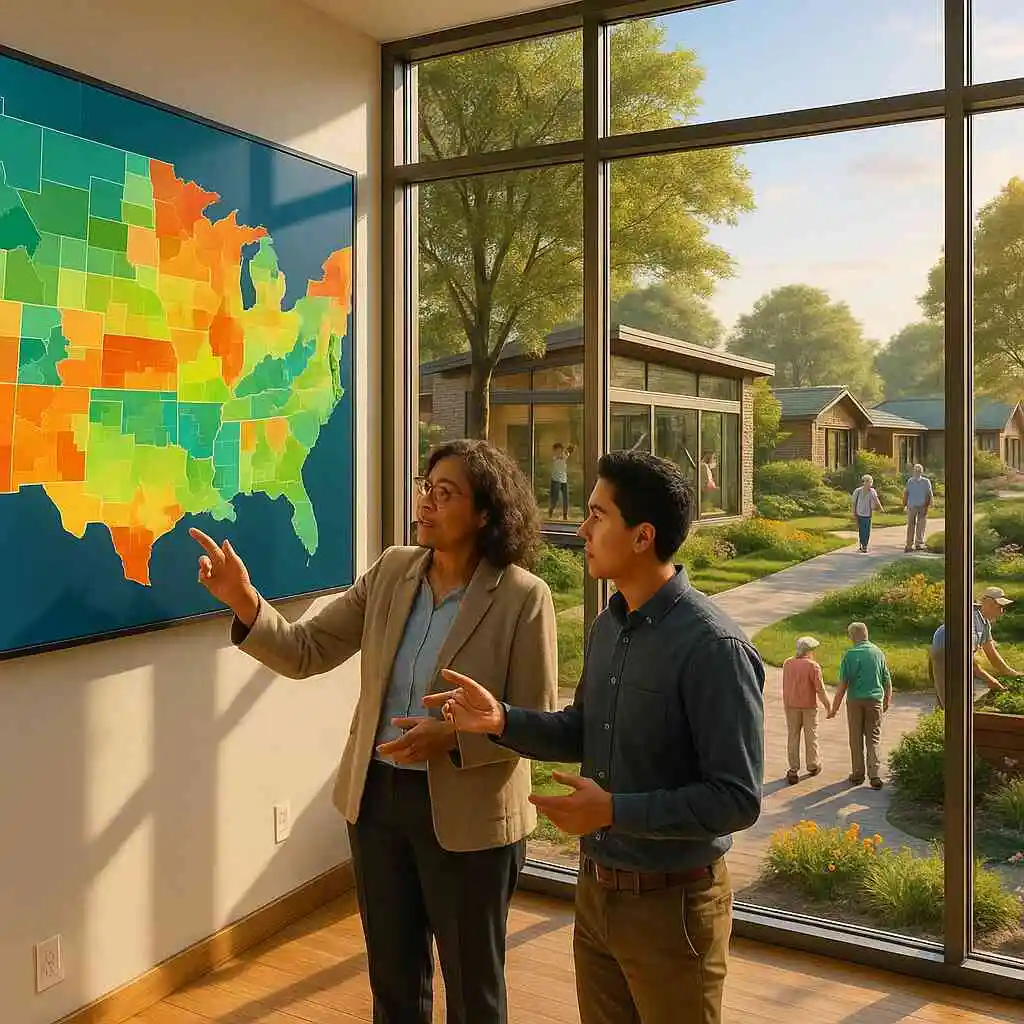
Demographers begin every senior housing pipeline analysis by translating raw census statistics into vivid heat maps. These graphics illustrate county level senior population growth rate spikes that numbers alone can hide. When planners overlay hospital catchment zones on the same map, prospective gaps in healthcare coverage emerge instantly. Consequently, senior living facility developers can pinpoint micro-markets where high growth intersects limited clinical infrastructure. This visual clarity ensures that independent living cottages, assisted living plans, and long-term care facility wings open precisely where older residents already cluster.
Yet raw population growth means little without age-band segmentation. Analysts separate adults aged 55-64, 65-74, and 75-plus to mirror real care trajectories. Communities for seniors 55+ often desire active-adult amenities, whereas cohorts above 75 lean toward enhanced personal care. By breaking data into these brackets, heat maps reveal whether a county needs more senior apartment rentals or expanded nursing homes for the elderly. Investors thereby avoid overbuilding the wrong housing options for seniors.
Economic and policy signals influencing assisted living locations and long-term care facility need assessment
Macro-economic health sways every senior living community plan. Rising median household income supports premium memory-care suites, while wage stagnation encourages value-oriented rental housing for seniors. Moreover, property-tax abatements and low-interest municipal bonds frequently determine which assisted living locations break ground first. Savvy developers therefore track legislative calendars and zoning hearings as closely as construction costs. When incentives align, projects launch sooner, locking in prime market share before competitors react.
In parallel, state certificate-of-need rules regulate bed counts for nursing homes for the elderly. Tight caps can artificially restrict supply, inflating waitlists and signaling latent demand. Policy analysts flag these mismatches early, allowing operators to petition for additional licenses or pursue alternative care models. Simultaneously, Medicare reimbursement reforms shape profitability projections for long-term care facility wings. Facilities that anticipate funding shifts preserve margins while safeguarding resident services.
Predicting occupancy rates for a senior living facility with integrated healthcare resource planning
Accurate occupancy models unite demographic projections with healthcare capacity analytics. Planners start by estimating chronic-disease prevalence among future residents using regional electronic health record datasets. Next, they compare those figures against local physician panels, rehabilitation clinics, and hospice networks. If provider scarcity looms, a new senior living facility may need to embed telehealth hubs or recruit on-site nurse practitioners. These enhancements elevate care quality while stabilizing census levels.
Financial officers then layer operating metrics onto the clinical picture. They blend historical move-in velocity, seasonal turnover, and marketing conversion rates into stochastic simulations. The result is a dynamic forecasting dashboard that updates weekly as real inquiries arrive. Because the model links census predictions to staff scheduling, leaders keep labor costs aligned with true acuity. Ultimately, predicting occupancy rates for a senior living facility becomes a living process rather than a static spreadsheet exercise.
Search behavior from the assisted living locator and senior living near you digital footprints
Every evening, search engines capture thousands of “senior living near me” queries. By mining anonymized click-stream data from the Senior Living Facilities assisted living locator, analysts watch consumer interest shift block by block. A surge in queries mentioning pet-friendly policies, for instance, signals rising demand for lifestyle-oriented senior housing. Marketing teams can then update community webpages to highlight dog parks and grooming stations before competitors notice.
Furthermore, keyword strings reveal budget expectations and urgency. Phrases like “affordable senior living near” often spike after local plant closures, warning operators about price sensitivity. Conversely, “luxury senior living in” searches correlate with waterfront condominium launches and upscale retail growth. Integrating these insights with county heat maps produces a nuanced senior housing demand outlook that blends intent with demographics. Such real-time intelligence keeps outreach campaigns relevant and cost-effective.
Detecting regional supply and demand gaps and market saturation for rental housing for seniors
Finally, developers cross-reference permit databases, occupancy audits, and lead funnels to detect looming oversupply. If multiple projects open within one zip code, rental discounts may follow, eroding returns. Conversely, rural corridors sometimes show high inquiry volumes yet few available beds, presenting blue-ocean opportunities. A quick glance at the senior housing demand outlook in Florida illustrates how coastal counties can be saturated while inland areas remain underserved.
Regional benchmarking also highlights migration patterns. The retirement migration impact on senior living in Texas, for example, demonstrates how inbound snowbirds strain existing assisted living plans each winter. By comparing those flows against staffing pipelines, operators mitigate burnout and maintain service standards. Moreover, integration with U.S. population projections for adults 65+ confirms whether observed spikes are temporary or structural. This triangulated approach protects investors and safeguards resident satisfaction.
Epilogue: From Forecast to Fulfillment in Senior Living
Capacity planning for senior apartment rentals and nursing homes for the elderly
Effective capacity planning starts with a granular senior living facilities demand forecast anchored in county-level growth data. Analysts translate that forecast into bed counts for nursing homes for the elderly and square footage for active apartments. An accurate nursing home utilization forecast for the elderly prevents costly idle wings or emergency overflow scenarios. They also map arrival cohorts against staff ratios to prevent caregiver shortages during seasonal illness peaks. For senior apartment rentals, planners model elevator waiting times, parking demand, and shared amenity usage. This multidimensional senior housing pipeline analysis keeps future residents comfortable while preserving margin integrity.
Predictive algorithms now adjust capacity assumptions weekly as leasing inquiries shift across zip codes. When sudden interest spikes, temporary furnishings or convertible common areas buy operators extra breathing room. Conversely, slow quarters trigger marketing campaigns or concierge upgrades rather than permanent overbuilding. Such agility supports more accurate predicting of occupancy rates for a senior living facility across economic cycles. Residents benefit from stable staffing and uninterrupted programming, reinforcing community trust. A parallel long-term care facility needs assessment verifies whether additional skilled beds remain justified before capital deployment.
Investor outlook and market feasibility for new senior living developments
Capital allocation decisions hinge on transparent metrics rather than intuition alone. Lenders now examine senior facility performance by U.S. region dashboards before extending credit. These comparative scorecards reveal absorption speed, turnover cost, and rental housing for seniors market projection accuracy. A senior living in metropolitan areas often demands study often highlights transportation costs or wage premiums that alter break-even points. When scores exceed benchmarks, financing terms improve and groundbreakings accelerate. Conversely, weak demand signals prompt joint ventures to pivot toward outpatient wellness centers or memory-care retrofits.
Feasibility studies incorporate inflation scenarios, insurance volatility, and regulatory shifts that influence operating expense curves. They also quantify competitive barriers like certificate-of-need caps or zoning height restrictions. Scenario modeling then feeds an investor outlook for senior living assets that spans pessimistic, base, and ambitious ranges. Stakeholders revisit those scenarios quarterly, updating them with live lead conversion numbers from the assisted living locator. The cycle closes with a senior living near local market analysis that validates micro decisions against neighborhood sentiment.
Innovative design trends and integrated care model adoption in seniors living community projects
Innovation now starts at the blueprint stage, where architects co-create spaces with future residents through virtual workshops. The result is biophilic corridors, sensory gardens, and flexible studios that adapt as acuity changes. Such innovative design trends in senior living facilities reduce relocation trauma and support lifelong independence. Communities embed telehealth pods, robotic medication dispensers, and e-bike charging to meet tech-savvy expectations. These features also lower per capita staffing costs, strengthening long-term profitability. These breakthroughs resonate strongly with communities for seniors 55+, who prize autonomy and vibrant programming.
Integrated care model adoption further blurs the lines between housing and healthcare. Partnerships with local hospitals enable on-call specialists and bundled payment pathways right inside the seniors’ living community. Residents transition seamlessly from independent to assisted living plans without changing addresses. Families therefore experience a continuum of trust rather than fragmented service silos. Regulators praise this continuum of care approach for streamlining Medicare documentation while elevating clinical outcomes. Predictive analytics for senior living demand guide capacity tweaks as residents shift along the continuum.
Creating resilient senior housing ecosystems that adapt to baby boomer retirement migration
Macro maps show older adults relocating along sunbelt corridors, coastal towns, and university enclaves. Operators who track the baby boomer retirement migration effect on senior housing redeploy marketing spend before buses even leave northern driveways. They pre-position staff apartments, clinic contracts, and transport fleets to absorb the incoming wave. This anticipation shields residents from waitlists and ensures community culture remains balanced. It also preserves reputation equity that generic competitors struggle to match.
Resilience extends beyond relocation trends to climate shocks, pandemics, and civic policy swings. Communities diversify energy sources, digitize supply chains, and cultivate multi-state referral networks to weather disruption. They share best practices across regional learning collaboratives, strengthening collective agility. Together, these measures fulfill the promise of senior living near you that feels secure, connected, and future-proof. Families recognize that foresight today guarantees comfort tomorrow, and they choose Senior Living Facilities to guide every step.
Frequently Asked Questions
 Frequently Asked Questions
Question: How do Senior Living Facilities create an accurate senior living facilities demand forecast for my county?
Answer: We blend county-level senior population growth rate heat-mapping with real-time lead data from our assisted living locator. By layering migration trends, economic signals, and healthcare resource planning for older adults, we pinpoint the precise mix of senior apartment rentals, assisted living plans, and nursing homes for the elderly your market will need over the next 5-10 years. The result is a senior housing pipeline analysis you can trust when deciding where and how much to build or expand.
Question: What factors are considered when predicting occupancy rates for a senior living facility, and how can your platform help maintain high census levels?
Answer: Our models unite demographic analysis for communities for seniors 55+ with live search behavior-everything from luxury “senior living near me” clicks to budget-minded “affordable senior living near” queries. We track seasonal waitlist trends, staff-to-resident ratios, and policy changes that affect long-term care facility reimbursement. The Senior Living Facilities dashboard updates these inputs weekly, giving operators a forward-looking senior living near you occupancy forecast that keeps marketing spend, staffing schedules, and amenity programming perfectly aligned with true demand.
Question: In the blog Forecasting Demand for Senior Living Facilities Near You, you highlight demographic analysis for communities for seniors 55+. How do you gather and use that data to guide your decision?
Answer: We pull age-banded census tables, Medicare claims, and regional electronic health records to understand chronic-disease prevalence and lifestyle preferences. When we overlay that with our nationwide search and inquiry streams, we produce a housing options for seniors demand outlook that shows exactly where independent villas, memory-care suites, or long-term care facility wings will be most valued. This evidence-based approach eliminates guesswork and helps families and investors choose communities that will thrive for decades.
Question: Can Senior Living Facilities help investors spot market saturation or supply gaps in assisted living locations and rental housing for seniors?
Answer: Absolutely. We cross-reference building permit filings, occupancy audits, and community waitlist lengths to reveal regional supply and demand gaps for senior housing. If your target zip code shows oversupply risk, we flag it early so you can pivot to underserved corridors. Conversely, we identify blue-ocean opportunities where senior living facilities demand forecast data that shows high inquiry volume but limited existing stock-maximizing your return on investment.
Question: How do innovative design trends and integrated care models influence your housing options for seniors’ demand outlook?
Answer: Search trends reveal growing interest in wellness studios, telehealth pods, and pet-friendly green spaces. Our predictive analytics for senior living demand quantifying how these features boost move-in velocity and length of stay. We also analyze hospital partnership opportunities to embed seamless care transitions inside a seniors’ living community. By forecasting the revenue impact of these design choices, we guide developers toward resilient, future-proof senior living facilities that consistently attract today’s baby boomers and tomorrow’s active adults.
Admin
Expert contributor specializing in senior living care. Dedicated to providing families with clear, actionable advice.